
A staircase is often one of the largest unused decorating opportunities in a home. While homeowners spend considerable time styling their living rooms, bedrooms, kitchens, and entryways, staircase walls can easily remain completely empty.
That is a missed opportunity.
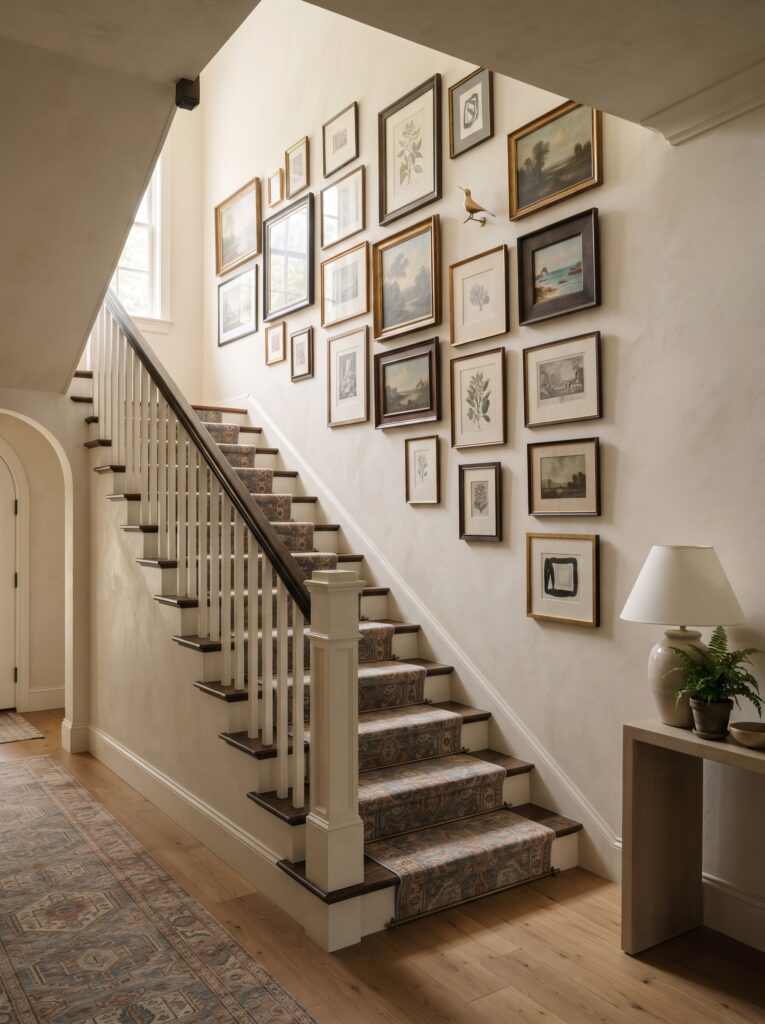
A staircase wall has the perfect amount of vertical space for artwork, photographs, vintage pieces, mirrors, and collected decorative details. With the right arrangement, an ordinary staircase can become one of the most visually interesting areas in the entire home.
One particularly timeless approach is a collected staircase gallery wall.
Instead of hanging a row of identical frames, this style combines different artwork sizes, frame finishes, textures, and subjects to create a relaxed but sophisticated arrangement. The result feels personal, layered, and thoughtfully designed rather than mass-produced.
This decorating approach works especially well with traditional, transitional, vintage, organic, and modern-classic American interiors.
If you are searching for staircase wall decor ideas, staircase gallery wall ideas, hallway wall decor, gallery wall inspiration, or elegant home decorating ideas, the following guide will help you create a beautiful arrangement while avoiding the most common styling mistakes.
Why Staircase Walls Are Perfect for Gallery Displays
A staircase naturally creates movement.
The steps rise gradually, which means artwork can follow the architectural direction of the staircase.
Rather than treating the wall like a flat rectangle, you can create a composition that visually moves upward.
This makes the staircase feel connected to the rest of the home.
A gallery wall also gives homeowners an opportunity to display things that may not have a natural place elsewhere.
You can combine:
- Family photographs
- Landscape artwork
- Botanical prints
- Vintage paintings
- Architectural sketches
- Abstract pieces
- Small mirrors
- Decorative plates
- Sculptural wall objects
The combination creates a sense of history and personality.
1. Start by Studying the Staircase
Before purchasing artwork, look carefully at the architecture.
Ask yourself:
- Where does the staircase begin?
- Where does it turn?
- How high is the wall?
- Is the ceiling open above it?
- Where are the handrails?
- Is there a landing?
- Is the wall visible from the entryway?
- Is there furniture nearby?
These details should determine your gallery layout.
A staircase gallery wall should feel connected to the architecture rather than randomly placed on it.
If the stairs rise from left to right, the artwork can gradually rise in the same direction.
If the staircase turns at a landing, consider creating two connected gallery sections rather than forcing everything into one straight line.
2. Choose a Color Story Before Choosing Frames
A collected gallery wall does not mean that every piece needs to match.
However, some common colors should connect the artwork.
For a sophisticated American home, consider palettes such as:
Warm Neutral
- Cream
- Beige
- Brown
- Black
- Soft gold
Earthy
- Olive
- Rust
- Taupe
- Walnut
- Ivory
Classic
- Navy
- Burgundy
- Cream
- Dark wood
- Antique brass
Minimal
- Black
- White
- Warm gray
- Natural wood
A consistent color story makes different artwork feel like part of one collection.
3. Mix Frame Styles Carefully
One of the biggest advantages of a collected gallery wall is that frames do not need to be identical.
You can mix:
- Dark wood
- Light wood
- Aged brass
- Matte black
- Antique gold
- Thin natural frames
But there should still be some repetition.
For example, if you use dark wood in several frames, repeat it throughout the arrangement.
If you introduce brass, use it in more than one location.
This creates visual continuity.
The goal is variation with connection.
4. Combine Different Artwork Sizes
A gallery wall becomes more interesting when artwork comes in different sizes.
You might combine:
- One large landscape
- Two medium paintings
- Several small botanical prints
- A few small photographs
- One unusual decorative object
Large pieces create anchors.
Smaller pieces fill the surrounding space.
If everything is exactly the same size, the arrangement can look more like an office display than a collected home gallery.
5. Use a Large Piece as an Anchor
If your staircase wall is large, start with one substantial artwork.
A landscape painting works particularly well because it naturally introduces depth and color.
Other possibilities include:
- Oversized botanical artwork
- Vintage portrait
- Abstract painting
- Architectural drawing
- Large black-and-white photograph
Place the anchor piece somewhere around the visual center of the composition.
Then build smaller pieces around it.
This makes the gallery easier to organize.
6. Follow the Angle of the Staircase
This is one of the most important staircase gallery wall rules.
The arrangement should generally follow the direction of the stairs.
Imagine an invisible diagonal line moving upward.
Your artwork can gradually follow that line.
However, you do not need to create a perfectly straight diagonal.
A slightly relaxed arrangement often looks more natural.
Keep the overall shape visually connected to the staircase.
This prevents the gallery from feeling disconnected from the architecture.
7. Leave Breathing Room Between Frames
A common mistake is placing artwork too close together.
The individual pieces need enough space to remain visually distinct.
At the same time, excessive gaps can make the gallery feel fragmented.
A useful approach is to keep spacing relatively consistent while allowing slight variation around unusually shaped pieces.
The arrangement should feel intentional without looking mechanically measured.
8. Add Small Landscapes for a Timeless Look
Landscape artwork is particularly effective on staircase walls.
Consider:
- Countryside scenes
- Mountains
- Coastal landscapes
- Forest paintings
- Old-world architecture
- Botanical gardens
- Rural American scenes
Muted landscapes work especially well with neutral interiors because they introduce color without becoming overwhelming.
You can also choose artwork that includes colors already present in your home.
For example, if your staircase has walnut wood and cream walls, choose artwork containing subtle brown, olive, beige, or muted blue tones.
9. Botanical Prints Add a Softer Element
If paintings feel too traditional, botanical prints can create a lighter interpretation.
Fern illustrations, pressed-leaf artwork, flower studies, and botanical drawings work beautifully in hallway and staircase spaces.
They can also help bridge traditional and modern decorating styles.
For a more contemporary look, use simple botanical artwork with clean frames.
For a vintage appearance, choose aged paper tones and antique-style frames.
10. Add One Unexpected Element
A gallery wall does not have to contain only rectangular pictures.
One unexpected object can make the arrangement much more memorable.
Consider:
- A small mirror
- Decorative plate
- Woven wall piece
- Sculptural object
- Vintage clock
- Small textile
- Architectural fragment
Do not add too many unusual objects.
One or two are enough.
The goal is to create curiosity.
11. Consider Family Photography
A staircase is also an excellent place for family photographs.
Instead of displaying every photograph you own, choose a small collection with a visual connection.
Black-and-white photography is particularly easy to integrate because it works with almost any color palette.
You can also mix family photographs with artwork.
For example:
Landscape + family photo + botanical print + abstract artwork
This creates a gallery that feels personal rather than purely decorative.
12. Use Black-and-White Photography for a Modern Look
If your home is more contemporary, a black-and-white gallery wall can create a sophisticated appearance.
Choose photographs with different compositions.
For example:
- Architecture
- Travel
- Portraits
- Nature
- Street photography
Use mostly similar frame finishes to keep the arrangement cohesive.
Black frames against a warm cream wall can look especially striking.
13. Try a Vintage Gallery Wall
For a more traditional American interior, consider a vintage-inspired arrangement.
Look for artwork with:
- Faded colors
- Antique-style frames
- Botanical subjects
- Landscapes
- Portraits
- Architectural drawings
Do not worry if every piece looks slightly different.
The imperfections are part of the charm.
A vintage-inspired staircase gallery should feel as though pieces were collected gradually over many years.
14. Don’t Ignore the Landing
If your staircase includes a landing, use it.
The landing can become a natural pause point in the gallery.
You might place a larger artwork there or use a small grouping of pieces.
If there is enough floor space, a narrow console table can also provide an opportunity for styling.
Add:
- A lamp
- Small artwork
- A ceramic vase
- A few books
- A small plant
Keep it relatively simple because the wall itself is already visually active.
15. Coordinate With the Stair Runner
If your staircase has a runner, consider its colors when selecting artwork.
The gallery does not have to match the runner exactly.
Instead, repeat one or two colors.
For example, a runner with muted olive and beige could connect with artwork containing similar tones.
This small relationship can make the entire staircase feel more cohesive.
16. Consider the Handrail and Woodwork
Architectural finishes are part of the design.
If your staircase has dark walnut handrails, dark wood frames can reinforce that material.
If the railing is painted white, natural wood or black frames can create contrast.
If your home has brass hardware, an occasional brass frame can connect the gallery with the rest of the house.
Good interior design often comes down to these small repeated details.
17. Use Mirrors Strategically
Mirrors can be particularly useful on darker staircases or narrow hallways.
A small vintage mirror among artwork can reflect light and introduce another shape.
Round mirrors are useful because most gallery walls contain many rectangles.
The curved shape creates contrast.
However, be careful about placement.
You do not want a mirror positioned directly opposite a cluttered area.
Instead, use it to reflect natural light, architectural details, or a visually attractive part of the home.
18. Create a More Minimal Gallery
A collected gallery wall does not have to be maximalist.
For a quieter look, use:
- Three to five large pieces
- Similar frames
- Plenty of wall space
- Neutral artwork
- Consistent colors
This works especially well in contemporary or transitional homes.
The arrangement still has personality without overwhelming the staircase.
19. Create a More Eclectic Gallery
If you love personality, go further.
Mix:
- Paintings
- Photographs
- Drawings
- Mirrors
- Textiles
- Sculptural objects
Use a consistent color story to prevent the arrangement from becoming chaotic.
Eclectic does not mean random.
It means different elements are intentionally combined.
20. Think About Viewing Distance
A staircase gallery wall is usually viewed from several different angles.
You may see it:
- From the entryway
- From the bottom of the stairs
- While walking upstairs
- From the landing
- From an adjacent hallway
That means the composition needs to work as a whole.
Do not design it only from one viewpoint.
Step back regularly while arranging the pieces.
21. Make the Gallery Feel Collected Over Time
The most sophisticated gallery walls rarely look as though every frame was purchased during the same shopping trip.
Introduce variation.
Perhaps one piece looks antique.
Another can be contemporary.
Another can be handmade.
Another can be a family photograph.
The common denominator should be the overall palette and feeling.
This creates a sense of history.
22. Affordable Ways to Create the Look
You do not need original artwork for every frame.
You can create a beautiful gallery using affordable sources.
Look for:
- Vintage-inspired prints
- Digital artwork
- Thrifted frames
- Estate-sale artwork
- Family photographs
- Children’s artwork
- Handmade pieces
- Repurposed frames
One of the easiest ways to make affordable art look more elevated is to use a good-quality mat and a substantial frame.
A simple print inside a beautiful frame can look surprisingly sophisticated.
23. Thrifted Frames Can Add Character
If you want a genuinely collected appearance, thrift stores and antique markets can be useful sources for frames.
Look for frames with interesting details.
They do not need to match.
You can even repaint or refinish selected pieces to create a more consistent palette.
For example, a collection of random wooden frames can be lightly refinished in similar walnut tones.
The result can look custom without requiring a large budget.
24. Use Artwork to Tell a Story
Instead of choosing pieces randomly, create a subtle theme.
Your gallery might tell a story about:
Nature
Travel
Family
Architecture
American landscapes
Botanical studies
Old-world art
This makes the collection feel intentional.
You can also combine themes as long as the colors connect them.
25. Common Staircase Gallery Wall Mistakes
Hanging Everything Too High
The artwork should relate to the people using the staircase, not only the ceiling height.
Making Every Frame Identical
Uniformity can make the gallery feel generic.
Using Too Many Colors
A controlled palette creates sophistication.
Ignoring the Stair Angle
The gallery should visually relate to the movement of the staircase.
Overcrowding the Wall
More artwork does not automatically mean better design.
Choosing Pieces Without Considering the Rest of the Home
The staircase should feel connected to nearby rooms.
A Simple Formula for a Sophisticated Staircase Gallery
If you want an easy starting point, try:
1 large artwork + 2 medium pieces + 4–6 smaller pieces + 1 unusual object + consistent color palette
Then adjust the number of pieces according to the size of your wall.
For a smaller staircase, you may need significantly fewer.
For a large open staircase, you can expand the arrangement.
Conclusion
A staircase wall can become much more than an empty passage between floors. With thoughtful artwork, mixed frames, natural colors, and a little creativity, it can become one of the most personal design features in your home.
The secret is not to make everything perfectly coordinated. Instead, focus on creating connection, rhythm, balance, and personality. Mix old and new. Combine large and small. Repeat a few colors. Let the staircase architecture guide the arrangement. And most importantly, choose pieces that actually mean something to you.
A beautiful staircase gallery should feel like a collection of memories, interests, and objects gathered over time—not simply a wall filled with decorations.
That is what gives this style its timeless appeal and makes it work so well in traditional, transitional, vintage, and modern American homes.
- Outdoor Patio Ideas for a Cozy Late-Summer to Fall Transition
- Laundry Room Organization Ideas That Look Beautiful and Built-In
- Staircase Wall Decor Ideas: How to Create a Collected Gallery Look
- Library-Inspired Home Office Ideas That Make Working From Home Feel Luxurious
- Chocolate Brown Dining Table Ideas for a Warm and Elegant Fall Home