
You do not need an entire room to create a beautiful reading space.
Sometimes the most inviting reading nook is tucked into a quiet corner of a bedroom, beside a window, underneath a staircase, at the end of a hallway, or inside an otherwise unused section of a home office. With the right chair, lighting, textiles, books, and a few carefully chosen accessories, even a small corner can become a cozy retreat that feels intentional and luxurious.
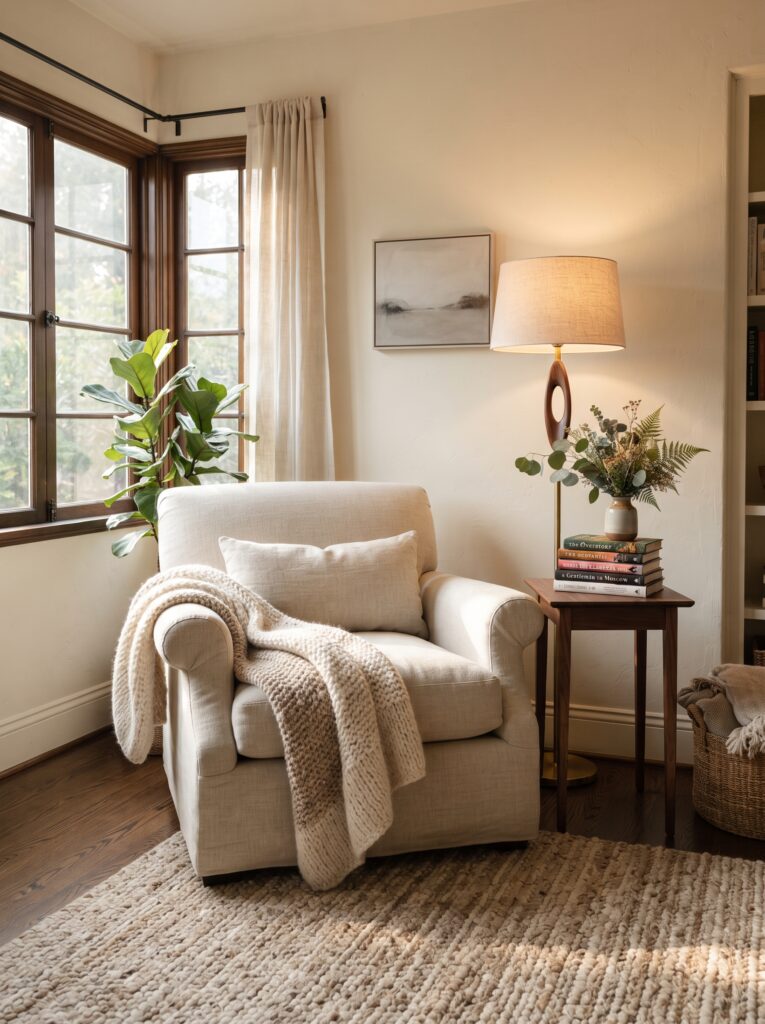
For homeowners in the United States, small reading nooks are especially useful because they can work in apartments, condos, townhouses, suburban homes, and larger houses alike. A reading corner can be designed around the space you already have rather than requiring a major renovation.
Current Pinterest trend reporting has also shown increased interest in reading-related interiors and small-space seating, including rising searches for comfortable reading chairs for small spaces and reading nook ideas.
The best part is that a reading nook does not have to look overly traditional. You can create a modern reading corner, a cozy minimalist nook, a sophisticated library-inspired space, or a warm transitional retreat that blends naturally with the rest of your home.
What Is a Reading Nook?
A reading nook is a dedicated small area designed primarily for reading, relaxing, and spending quiet time.
Unlike a full home library, a reading nook usually requires very little space.
A basic reading corner can include:
- A comfortable chair
- A small side table
- A reading lamp
- A few favorite books
- A soft throw blanket
- A small rug
- A plant or decorative object
You can add more elements depending on the size of the space.
The goal is to create a comfortable environment where you actually want to sit.
Why Small Reading Nooks Work So Well
Many areas of a home are used only occasionally.
A corner may be technically part of the living room but remain empty. A bedroom may have space beside the window that serves no purpose. A hallway might have a wider section that could accommodate a chair.
A reading nook gives that unused space a function.
It can also add visual warmth to a room without requiring a complete decorating makeover.
Instead of filling the corner with random furniture, you create a purposeful little retreat.
1. Start With the Right Chair
The chair is usually the most important element in a reading nook.
Comfort should come before appearance.
A beautiful chair that becomes uncomfortable after ten minutes will not create a useful reading space.
Look for a chair that provides:
- Good back support
- Comfortable seat depth
- Soft upholstery
- Enough room to change positions
- A supportive armrest
- Appropriate scale for the room
For small spaces, avoid extremely oversized lounge chairs unless you have enough floor area.
A compact upholstered armchair can provide the same cozy feeling without overwhelming the room.
2. Choose a Chair That Fits Your Decorating Style
Your reading chair should connect with the rest of your home.
For a modern interior, consider a clean-lined upholstered chair.
For a traditional home, a classic wingback or tailored armchair can work beautifully.
For a relaxed space, consider a textured boucle, linen, or cotton chair.
For a luxury-inspired look, try:
- Oatmeal upholstery
- Warm beige
- Chocolate brown
- Camel
- Deep olive
- Soft cream
Neutral upholstery is particularly versatile because it allows you to change accessories seasonally.
3. Place the Reading Nook Near Natural Light
If possible, place your reading corner near a window.
Natural daylight creates a pleasant atmosphere and makes the area feel more connected to the outdoors.
A window-side reading nook can be especially beautiful in the morning or late afternoon.
However, avoid positioning the chair directly in harsh sunlight if it makes the space uncomfortably warm.
A lightweight curtain can soften bright daylight while maintaining the connection with the outdoors.
4. Add Dedicated Reading Lighting
Natural light is wonderful during the day, but a reading nook needs good artificial lighting for evenings.
A floor lamp beside the chair is one of the easiest solutions.
You can also use:
- Adjustable wall sconces
- Swing-arm lamps
- Table lamps
- Arc lamps
- Small pendant lights
The light should illuminate your reading area without creating harsh glare.
A lamp with an adjustable shade is especially useful because you can direct the light toward your book.
5. Use Warm Lighting for a Cozy Atmosphere
The wrong lighting can make an otherwise beautiful reading corner feel cold.
For a relaxing evening environment, warmer light usually creates a softer atmosphere.
Combine the reading lamp with ambient lighting from the surrounding room.
For example:
Floor lamp + table lamp + soft room lighting
This creates layers rather than one harsh source of illumination.
6. Add a Small Side Table
A reading nook becomes much more functional with a small table.
You need somewhere to place:
- Your book
- Coffee or tea
- Reading glasses
- Phone
- Candle
- Small decorative object
The table does not need to be large.
A compact round table can work especially well in a small corner.
Choose a material that complements the chair.
Walnut, oak, marble-look stone, brass, or dark wood can all work beautifully.
7. Use a Small Ottoman
If you have enough space, an ottoman can make your reading nook significantly more comfortable.
It provides a place to rest your feet and can also introduce another texture or color.
For a sophisticated look, choose an ottoman in:
- Cream
- Camel
- Brown
- Olive
- Taupe
A round ottoman can soften a space filled with rectangular furniture.
8. Add a Soft Throw Blanket
A throw blanket makes a reading corner feel immediately more inviting.
Drape it casually over the chair rather than folding it too perfectly.
Choose a fabric with visible texture.
Good options include:
- Chunky knit
- Cotton
- Linen
- Wool
- Woven fabric
A textured throw can add warmth without requiring additional decorative objects.
9. Create a Small Book Collection
Books are essential to the personality of a reading nook.
You do not need a giant library.
A small stack of your favorite books on the side table can be enough.
You can also place a narrow bookcase beside the chair if the room allows it.
Organize books according to how you naturally use them rather than trying to create a perfectly styled display.
Your reading nook should be functional first.
10. Use a Small Bookcase
If you have a little more space, a vertical bookcase can provide storage without taking up much floor area.
Choose a narrow bookshelf with several shelves.
You can combine books with:
- Small ceramics
- Framed artwork
- A small plant
- Decorative boxes
- Personal objects
Do not fill every shelf.
Leaving some empty space helps the bookcase feel lighter.
11. Turn an Unused Corner Into a Reading Nook
You do not need a designated reading area.
Look around your home for spaces that are currently underused.
Potential locations include:
- Beside a bedroom window
- Next to a fireplace
- Near a staircase
- At the end of a hallway
- Beside a living room window
- In a home office
- Inside a large walk-in closet
- Beside a built-in bookcase
Once you identify the corner, measure it before buying furniture.
This prevents the common mistake of choosing a chair that is too large.
12. Small Apartment Reading Nook Ideas
Apartment living often requires furniture to perform multiple functions.
A small reading nook can still work beautifully.
Try placing a compact chair beside a window with:
- A narrow side table
- Wall-mounted lamp
- Small rug
- Vertical bookshelf
If floor space is extremely limited, consider mounting shelves above the chair instead of using a bookcase.
This keeps the floor area open.
13. Create a Bedroom Reading Corner
A bedroom reading nook can create a relaxing transition between daytime and bedtime.
Place a comfortable chair near a window or in an unused corner.
Add:
- Soft lighting
- Small side table
- Books
- Throw blanket
- Decorative pillow
- Small plant
Keep the color palette calm.
Cream, beige, warm gray, muted green, and natural wood are excellent choices for a peaceful bedroom reading corner.
14. Design a Living Room Reading Nook
A reading corner does not need to be completely separated from the living room.
Instead, it can become a secondary seating area.
Position a chair near a window or beside a bookcase.
Use a small rug underneath the chair to visually define the area.
This creates a subtle zone without requiring a wall.
15. Create a Reading Nook Under the Stairs
The area underneath a staircase is often difficult to use.
If the dimensions allow it, a compact reading chair can transform the awkward space.
Add:
- Wall-mounted reading light
- Small floating shelf
- Cushion
- Throw
- A few books
Because the ceiling may be lower, avoid oversized furniture.
Use the architecture as part of the design.
16. Make a Window Reading Nook
A window can become the natural focal point of your reading corner.
If you have a wide window ledge or enough floor space, place a chair slightly to the side so the view remains visible.
A small table and warm floor lamp can complete the arrangement.
For an especially cozy look, layer the area with soft textiles.
17. Create a Luxury Reading Nook on a Budget
A luxury-looking reading corner does not require expensive furniture.
Focus on a few details that have a strong visual impact.
Start with a comfortable chair in a refined neutral color.
Then add:
- A textured throw
- A sculptural lamp
- A small wood or stone table
- One beautiful vase
- A small stack of books
- A simple rug
Instead of buying many inexpensive decorations, choose fewer pieces with better shapes and textures.
18. Use a Neutral Color Palette
Neutral colors are particularly effective for reading spaces because they create a calm atmosphere.
Try combinations such as:
Cream + Walnut
Warm and timeless.
Beige + Olive
Natural and relaxing.
Taupe + Chocolate Brown
Sophisticated and cozy.
Ivory + Black + Wood
Modern and refined.
Camel + Cream + Brass
Warm and slightly luxurious.
You can introduce stronger colors through artwork or books.
19. Add a Small Rug
A rug visually separates the reading corner from the rest of the room.
For a small nook, a compact round or rectangular rug can work.
Choose something that complements the main room rather than competing with it.
A subtle geometric or vintage-inspired design can add personality.
20. Introduce One Plant
Plants can make a reading corner feel more alive.
You do not need a large indoor tree.
A small plant on the side table or a medium plant beside the chair can be enough.
For low-maintenance options, consider varieties appropriate for your home’s available light.
If the space receives very little natural light, decorative branches or high-quality faux greenery can provide a similar visual effect.
21. Use Wall Art Above the Reading Chair
A small artwork can give the reading corner a finished appearance.
Choose artwork that creates the atmosphere you want.
For example:
- Abstract art
- Botanical prints
- Landscape photography
- Vintage illustrations
- Minimal line drawings
- Literary-inspired artwork
Avoid choosing art simply because it matches the chair.
Instead, choose something that makes the corner feel personal.
22. Create a Book-Lover’s Reading Corner
If books are an important part of your life, let them become part of the design.
A narrow bookshelf can hold your favorite collection.
You can also display a few books on a side table.
For a cozy library-inspired atmosphere, combine books with:
- Warm wood
- Brass lighting
- Leather accents
- Darker artwork
- Soft textiles
This can make a small corner feel like a miniature private library.
23. Add a Personal Touch
A reading nook should feel like your space.
Add something meaningful.
It could be:
- A framed photograph
- A favorite artwork
- A travel souvenir
- A handmade ceramic
- A family heirloom
- A favorite blanket
These details prevent the space from feeling like a staged photograph.
24. Use Vertical Space
When floor space is limited, look upward.
Wall-mounted shelves can provide storage without making the corner feel crowded.
You can also install:
- Wall sconces
- Floating shelves
- Small artwork
- Vertical book storage
Using vertical space allows you to create a complete reading area while preserving valuable floor space.
25. Make the Corner Feel Separate Without Building a Wall
Sometimes you want the reading nook to feel like its own little retreat.
You can achieve this without construction.
Try:
- A small rug
- Different lighting
- A plant
- A narrow bookcase
- A side table
- A slightly different color palette
These visual signals tell the eye that the corner has a specific purpose.
26. Create a Cozy Evening Reading Nook
The atmosphere becomes particularly important at night.
Turn off harsh overhead lights and use layered lighting instead.
Turn on the reading lamp.
Add a soft throw.
Keep your favorite book on the side table.
You can also introduce a subtle candle or another decorative light source if appropriate for your space.
The result should feel peaceful rather than overly decorated.
27. Avoid Making the Reading Nook Too Crowded
Small spaces require restraint.
Avoid combining:
- Large chair
- Large ottoman
- Large table
- Large plant
- Large bookshelf
all in the same corner.
Choose one primary piece and build around it.
For a tiny nook, the chair may be the only substantial furniture item you need.
28. Measure Before You Buy
This is one of the most important practical steps.
Measure:
- Width of the available space
- Depth of the space
- Door clearance
- Walking path
- Distance from nearby furniture
- Window position
- Electrical outlet location
A beautiful chair is not useful if it blocks a doorway or makes the room difficult to navigate.
29. Make the Reading Nook Comfortable in Every Season
Your reading corner can change throughout the year.
Spring
Use lighter textiles, fresh greenery, and soft colors.
Summer
Choose breathable fabrics and lighter accessories.
Fall
Introduce warmer textures, deeper colors, and cozy throws.
Winter
Layer wool, chunky knits, candles, and warm lighting.
Small seasonal changes can keep the space feeling fresh without requiring a complete redesign.
30. Create a Reading Nook That You Actually Use
The most important question is not whether your reading nook looks beautiful.
It is whether you want to sit there.
Put your favorite books within reach.
Make the chair genuinely comfortable.
Place the lamp where you can actually read.
Keep a small table nearby.
Give yourself enough room to move.
A functional reading corner will naturally become one of the most enjoyable areas of your home.
Small Reading Nook Checklist
If you are starting from scratch, use this simple checklist:
Comfortable chair
Choose the best chair you can reasonably fit into the space.
Good lighting
Add a dedicated reading lamp.
Small table
Keep essentials within reach.
Books
Display your current favorites.
Soft textile
Add a throw or cushion.
Rug
Define the area visually.
Personal detail
Include something meaningful.
Natural element
Add a plant or branch when appropriate.
You do not need every item.
Start with the essentials and add details gradually.
Conclusion
A small reading nook can turn an overlooked corner into one of the most inviting spaces in your home. You do not need a dedicated library or a large floor plan. A comfortable chair, thoughtful lighting, a small table, a few favorite books, and soft textures can create a beautiful retreat almost anywhere.
The secret is to design around the space you already have. A window corner can become a peaceful morning reading spot. An empty section of the living room can become a cozy afternoon retreat. An awkward space beneath the stairs can become a tiny private library. Even a small apartment can accommodate a comfortable reading corner with the right furniture scale.
For a sophisticated look, focus on quality over quantity. Choose warm materials, refined neutral colors, comfortable furniture, and lighting that creates a relaxed atmosphere.
Most importantly, let the reading nook feel personal. It should be a place where you can put your phone down, pick up a book, settle into a comfortable chair, and enjoy a few quiet minutes.
That combination of comfort, function, and thoughtful design is what turns a simple corner into a truly special part of the home.
- Afrohemian Dining Room Ideas for a Warm, Collected and Sophisticated Home
- Warm Wood and Black Kitchen Ideas for a Timeless Designer Look
- Small Reading Nook Ideas That Turn Forgotten Corners Into a Cozy Luxury Retreat
- Curated Trinket Shelf Ideas: How to Create a Collected and Personal Home
- Neo Deco Entryway Ideas That Make Your Home Feel Instantly Expensive