
Home decor does not always have to be serious, neutral, or perfectly minimal. While calm beige interiors and clean-lined spaces will always have their place, there is something refreshing about a home that has personality. A playful interior can feel energetic, creative, unexpected, and deeply personal while still looking polished and sophisticated.
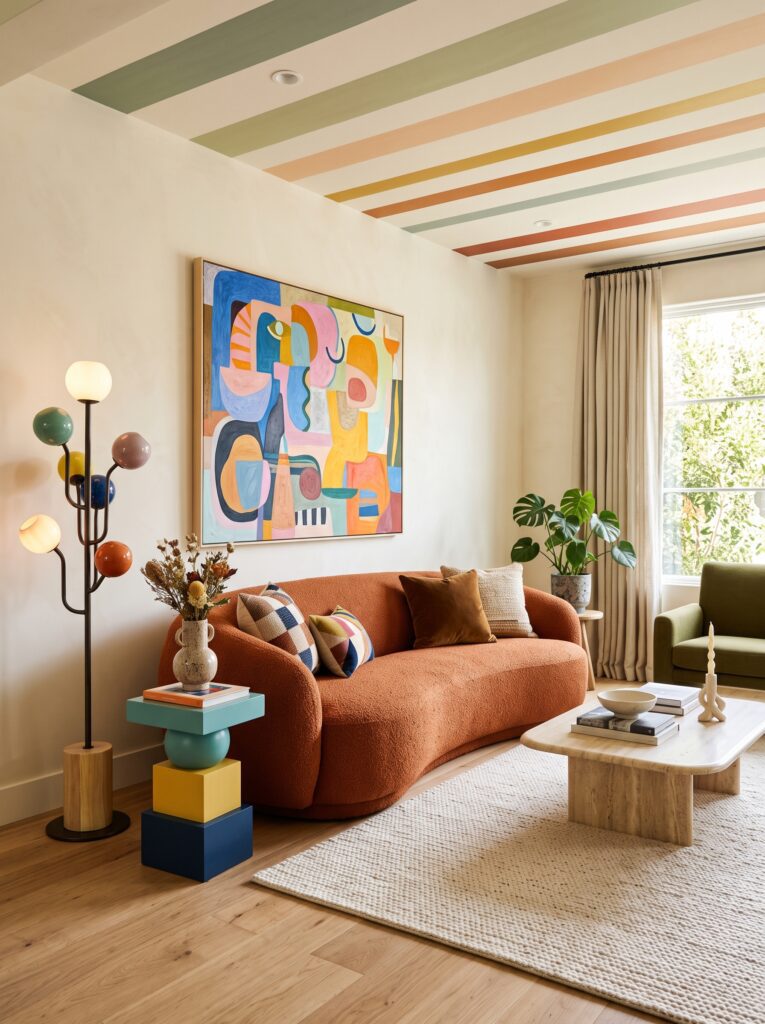
The secret is knowing how to introduce fun design elements without allowing the room to become visually chaotic.
This is where playful interior design becomes especially interesting. Instead of filling a room with random colors and patterns, playful decorating uses carefully selected surprises—such as striped ceilings, sculptural furniture, unusual lighting, colorful artwork, curved shapes, whimsical accessories, and unexpected combinations—to create a space that feels expressive without looking cluttered.
For homeowners searching for unique home decor ideas, colorful interior design inspiration, eclectic decorating ideas, maximalist home decor, or creative ways to make a home more interesting, playful interiors offer countless possibilities.
You do not have to completely redesign your house. Even one unexpected design feature can change the personality of a room.
What Is Playful Interior Design?
Playful interior design is an approach to decorating that prioritizes personality, creativity, visual surprise, and self-expression.
Instead of asking, “What is the safest choice?” playful design asks, “What would make this room more memorable?”
That might mean using a bold ceiling color, choosing a sculptural chair, adding an unusual lamp, experimenting with an unexpected wallpaper pattern, or displaying artwork that makes you smile.
However, playful design is not synonymous with clutter.
A successful playful interior usually has a visual hierarchy.
There is a dominant element, supporting elements, and quieter areas that allow the eye to rest.
This is what separates intentional maximalism from a room that simply contains too many things.
Why Playful Home Decor Is Gaining Attention
Interior design has been moving toward greater individuality.
Homeowners are increasingly interested in creating spaces that reflect their personalities instead of reproducing the same neutral room seen everywhere online.
This has created more interest in:
- Expressive color
- Vintage-inspired design
- Statement ceilings
- Sculptural furniture
- Unexpected patterns
- Eclectic decorating
- Decorative wallpaper
- Whimsical accessories
- Curved architecture
- Artistic interiors
Pinterest’s 2026 trend reporting includes FunHaus, a playful design direction inspired by circus-like visual elements, including bold stripes, sculptural forms, and unexpected decorative details.
This makes playful interiors particularly interesting for Pinterest content because the visual difference is immediately noticeable.
Start With One Unexpected Element
If you are new to playful decorating, do not change everything at once.
Choose one unexpected feature.
It could be:
- A striped ceiling
- A colorful chair
- A dramatic lamp
- A patterned rug
- A sculptural mirror
- A bold piece of artwork
- A colorful interior door
- An unusual side table
Once you have your statement element, build the rest of the room around it.
This creates a much more controlled result than choosing several dramatic elements independently.
Try a Striped Ceiling
One of the most unexpected ways to introduce personality into a room is by decorating the ceiling.
Most homeowners automatically think about walls, flooring, and furniture while leaving the ceiling plain.
A striped ceiling immediately changes that.
You could use:
- Thin stripes
- Wide stripes
- Tone-on-tone stripes
- Soft neutral stripes
- Bold contrasting stripes
- Vertical-looking architectural patterns
For a sophisticated result, consider using two closely related colors rather than extremely high contrast.
For example, cream and soft beige can create subtle movement.
For a more dramatic room, black and ivory or another high-contrast combination can become a major focal point.
Use Color in Unexpected Places
You do not need to paint an entire room a bright color to make it playful.
Instead, introduce color in places people do not expect.
Try painting:
- An interior door
- Window trim
- Built-in shelving
- The back of a bookshelf
- A ceiling
- A small hallway
- A fireplace surround
- Cabinet interiors
These smaller moments can make a home feel much more personalized.
A colorful interior door can become a visual surprise without changing the entire room.
Experiment With Sculptural Furniture
Furniture does not have to be purely functional.
A sculptural chair, curved sofa, unusual coffee table, or organically shaped stool can act almost like artwork.
Look for silhouettes featuring:
- Curves
- Arches
- Rounded edges
- Asymmetrical shapes
- Unusual proportions
- Sculptural bases
A single statement piece can give a neutral room an entirely new personality.
If the furniture itself is dramatic, keep the surrounding accessories simpler.
Choose an Unexpected Accent Chair
An accent chair is an easy way to experiment with playful design.
Instead of selecting another neutral chair, choose something with personality.
Consider:
- Curved silhouettes
- Patterned upholstery
- Bouclé texture
- Rich colors
- Stripes
- Vintage-inspired shapes
- Sculptural frames
The chair does not necessarily need to match the sofa perfectly.
In fact, contrast can make the room more interesting.
Add a Statement Lamp
Lighting can be one of the easiest ways to introduce personality.
A playful lamp can become a sculptural object even when it is switched off.
Look for:
- Oversized shades
- Sculptural bases
- Unexpected silhouettes
- Colored glass
- Ceramic lamps
- Vintage-inspired fixtures
- Organic forms
Place a statement lamp on a side table, console, desk, or shelf where it can be appreciated.
Make Your Lighting Part of the Artwork
Instead of treating lighting as an afterthought, think about how it contributes to the visual composition of the room.
A dramatic pendant can define a dining area.
A sculptural floor lamp can become a focal point beside a sofa.
A pair of unusual sconces can frame a piece of artwork.
Decorative lighting gives you an opportunity to add personality without taking up much floor space.
Use Pattern Strategically
Patterns are powerful tools for playful interiors.
However, using too many unrelated patterns can quickly make a room feel chaotic.
Start with one dominant pattern.
For example:
A striped rug could become the main pattern.
Then use a smaller geometric pillow and a subtle patterned artwork as supporting elements.
Keep at least one or two colors consistent across the patterns so they feel connected.
Mix Traditional and Modern Pieces
One of the easiest ways to create an eclectic interior is to combine furniture from different design eras.
A traditional wooden table can look beautiful with modern chairs.
A contemporary sofa can be paired with a vintage-style side table.
A classic rug can sit beneath a sculptural coffee table.
These contrasts create personality.
The room feels collected rather than purchased as a complete matching set.
Create a Playful Living Room
The living room is one of the best places to experiment with this style because it is naturally designed for comfort and socializing.
Start with a relatively calm foundation.
Then introduce personality through:
- Colorful artwork
- Sculptural seating
- Patterned pillows
- A statement rug
- Unusual lighting
- Decorative objects
- Curved furniture
You do not need every item to be bold.
One or two strong elements are usually enough.
Use Color Blocking
Color blocking can make a room feel contemporary and artistic.
Instead of painting the entire room one color, use two or more related colors to visually divide areas.
For example, a lower portion of a wall could be painted in a darker tone while the upper portion remains lighter.
You could also paint a large arch or geometric shape behind a desk or seating area.
Color blocking is especially useful for creating a visual focal point without purchasing new furniture.
Add a Colorful Interior Door
A colorful door can be a surprisingly effective design detail.
Imagine an otherwise neutral hallway with one door painted in a rich blue, green, burgundy, yellow, or another expressive shade.
The door becomes a small architectural statement.
This works particularly well in homes with simple white or neutral walls.
Make a Statement With Wallpaper
Wallpaper is one of the most effective ways to introduce personality.
If you are hesitant about covering an entire room, start with a smaller space.
Consider wallpapering:
- A powder room
- Entryway
- Reading nook
- Home office
- Closet
- Small hallway
Playful wallpaper can include stripes, abstract forms, florals, geometric patterns, or whimsical motifs.
In larger rooms, use wallpaper on one feature wall if you want a more restrained result.
Create a Playful Dining Room
Dining rooms are another excellent opportunity for expressive decorating.
Start with a simple dining table.
Then experiment with:
- Colorful dining chairs
- Sculptural lighting
- Patterned curtains
- Statement artwork
- Unusual centerpiece objects
- A bold rug
A large pendant above the dining table can create an immediate focal point.
If the chairs are colorful, keep the table relatively simple.
Use Unexpected Color Combinations
Playful design does not necessarily mean using every color in the rainbow.
Sometimes the most interesting combinations are unexpected pairings of two or three colors.
Consider combinations such as:
- Terracotta and dusty blue
- Olive and blush
- Burgundy and cream
- Mustard and navy
- Lavender and brown
- Deep green and pale pink
- Cobalt and warm beige
The key is repetition.
If you introduce a particular accent color in one location, repeat it subtly elsewhere.
This creates cohesion.
Try a Bold Fireplace Surround
A fireplace naturally attracts attention.
Instead of keeping it completely neutral, use it as an opportunity to introduce personality.
You could experiment with:
- Decorative tile
- Colored paint
- Patterned tile
- Sculptural plaster
- Contrasting trim
- Artwork above the mantel
If the fireplace is already visually strong, keep the surrounding furniture simple.
Give Built-Ins a Personality
Built-in shelves do not need to remain white.
Painting the interior or entire built-in structure in a contrasting shade can make it much more interesting.
For example, a neutral living room could feature deep green built-ins with natural wood shelves.
Style them with books, artwork, ceramics, and a few decorative objects.
Leave some shelves partially empty to maintain visual balance.
Create a Playful Bedroom
A playful bedroom should still feel relaxing.
Instead of filling the room with bold colors everywhere, introduce personality through one focal point.
Consider:
- A patterned headboard
- Colorful bedding
- A painted ceiling
- Sculptural bedside lamps
- Statement artwork
- Unexpected wallpaper
Keep the rest of the room relatively calm so it remains comfortable at night.
Use Curves to Soften the Room
Curved furniture and architectural details can make a room feel playful without adding bright color.
Consider:
- Rounded coffee tables
- Curved sofas
- Arched mirrors
- Rounded chairs
- Circular rugs
- Curved shelving
Curves create movement and contrast with the straight lines found in many modern homes.
Add Whimsical Accessories
Small decorative objects can add personality without changing the entire room.
Think about:
- Unusual vases
- Sculptural candles
- Characterful bookends
- Decorative figurines
- Artistic bowls
- Colorful trays
- Vintage-inspired objects
The key is editing.
Choose objects you genuinely enjoy rather than purchasing accessories simply because they are considered trendy.
Create a Gallery Wall With Personality
A gallery wall does not have to follow a strict grid.
Mix:
- Photography
- Abstract art
- Small paintings
- Graphic prints
- Vintage-style artwork
- Personal photographs
Vary the frame sizes while keeping one element consistent, such as color or material.
This creates an eclectic but intentional composition.
Make a Small Space More Interesting
Small rooms are perfect for playful experimentation.
A tiny entryway, powder room, laundry area, or hallway can handle a stronger design statement because the space is visually limited.
You can experiment with a bold wall color, patterned wallpaper, unusual lighting, or a decorative mirror without committing to the same design throughout your entire home.
These small moments can make the entire house feel more creative.
Playful Home Decor for Renters
Renting does not mean you have to live in a completely personality-free space.
Use removable or temporary changes whenever permitted.
Try:
- Removable wallpaper
- Peel-and-stick decorative elements
- Colorful textiles
- Artwork
- Freestanding lighting
- Decorative mirrors
- Statement rugs
- Colorful furniture
A colorful rug can dramatically change the appearance of a rental living room without changing the walls.
How to Balance Playful Design With Sophistication
This is one of the most important principles.
If everything is bold, nothing feels special.
Give your statement pieces room to breathe.
For example, if you choose a colorful sofa, use neutral walls and a relatively simple rug.
If you choose dramatic wallpaper, keep the furniture restrained.
If you use a striped ceiling, avoid adding multiple competing patterns.
Think of playful elements as punctuation marks.
They should make the room interesting without becoming the entire sentence.
Use Repetition to Create Cohesion
Even an eclectic room needs some connection between its elements.
Repetition is one of the easiest ways to achieve this.
If your artwork includes blue, introduce a small amount of blue through a pillow or decorative object.
If your furniture contains brass details, repeat brass in the lighting or hardware.
If your room has curved furniture, introduce another rounded shape through a mirror or side table.
These small repetitions help seemingly different elements feel intentional.
Create Controlled Maximalism
Maximalism does not mean filling every available surface.
Controlled maximalism means being bold while still editing the room carefully.
You can have:
A colorful rug, statement chair, artwork, sculptural lamp, and patterned pillows.
But not every item needs to compete for attention.
Choose a clear focal point and let the other elements support it.
This creates a room that feels energetic without becoming overwhelming.
How to Make a Neutral Room More Playful
If your home is currently very neutral, you do not need to completely redesign it.
Start small.
Add a colorful artwork.
Replace one accent chair.
Introduce a patterned rug.
Add a sculptural lamp.
Paint an interior door.
Change your throw pillows.
Add a statement vase.
These small changes can gradually introduce personality.
Playful Kitchen Ideas
Kitchens are usually highly functional spaces, but that does not mean they need to look predictable.
Consider adding personality through:
- Colorful bar stools
- Patterned backsplash
- Statement pendant lights
- Colorful cabinetry
- Decorative artwork
- Unusual hardware
- Open shelving
- Patterned window treatments
If the cabinetry is neutral, use lighting or seating as your statement element.
Playful Bathroom Ideas
Bathrooms are another great location for experimentation.
A small bathroom can handle dramatic wallpaper, colorful tile, an unusual mirror, or sculptural lighting.
For a more subtle approach, introduce personality through towels, artwork, a colorful vanity, or decorative hardware.
Powder rooms are especially suitable for bold design because they are small and often used for short periods.
Make Your Home Feel More Personal
The ultimate goal of playful design is not simply to follow a trend.
Your home should reflect you.
Display books you actually read.
Choose artwork that means something to you.
Use furniture that you genuinely enjoy.
Keep objects that remind you of places, people, or experiences.
Mix old and new pieces.
When design choices have personal meaning, the room naturally becomes more interesting.
Common Mistakes With Playful Interior Design
One of the biggest mistakes is adding too many statement pieces.
If every piece of furniture is unusual, the room can become visually exhausting.
Another mistake is using too many unrelated colors.
A limited color palette can still feel playful if the shapes, textures, and patterns are interesting.
Another issue is ignoring scale.
A very small room may not be able to accommodate several oversized statement pieces.
Finally, avoid decorating purely for social media.
Your home should be comfortable and functional in real life.
How to Create a Playful Home on a Budget
You can create personality without spending a fortune.
Start with paint.
A single painted wall, ceiling, door, or built-in can have a major impact.
Next, experiment with textiles.
Pillows, rugs, curtains, and throws are relatively easy ways to introduce pattern and color.
Thrift stores and secondhand marketplaces can also be excellent sources for unusual furniture and decorative pieces.
Sometimes the most memorable item in a room is something unexpected that you found rather than something purchased as part of a matching collection.
Conclusion
A beautiful home does not have to take itself too seriously. Playful interior design gives homeowners permission to experiment, express personality, mix styles, and create rooms that feel memorable rather than predictable.
The most successful playful spaces are not necessarily the ones with the most color or decoration. They are the spaces where unexpected details have been used intentionally. A striped ceiling can transform an ordinary room. A sculptural chair can become a piece of functional art. A colorful interior door can turn a hallway into a memorable moment.A statement lamp can completely change the atmosphere of a corner. The secret is balance.
Choose one strong idea, support it with complementary details, and allow quieter areas to give the room breathing space. Whether you prefer subtle playful accents or a more expressive maximalist interior, you can introduce personality gradually. Start with one unexpected detail that makes you happy. Then build from there.
Your home should not only look beautiful—it should feel like your home.
Save these playful interior design ideas for your next decorating project and use them to create a space that feels creative, welcoming, sophisticated, and uniquely yours.
- Afrohemian Dining Room Ideas for a Warm, Collected and Sophisticated Home
- Warm Wood and Black Kitchen Ideas for a Timeless Designer Look
- Small Reading Nook Ideas That Turn Forgotten Corners Into a Cozy Luxury Retreat
- Curated Trinket Shelf Ideas: How to Create a Collected and Personal Home
- Neo Deco Entryway Ideas That Make Your Home Feel Instantly Expensive