
A beautiful mirror can do much more than help you check your reflection. In interior design, mirrors are one of the most versatile decorating elements because they can make a room feel brighter, visually larger, more layered, and more finished.
Whether you live in a spacious suburban home, a city apartment, a cozy cottage, or a modern townhouse, the right decorative mirror can completely change the atmosphere of a space. An oversized mirror can make a small room feel more open, an antique mirror can introduce character, and an organic-shaped mirror can soften a room filled with straight lines.
The key is choosing a mirror that works with the architecture, furniture, lighting, and overall personality of your home.
If you are looking for simple ways to refresh your interior without replacing all your furniture, decorative mirrors are an excellent place to start.
Why Decorative Mirrors Are So Effective in Home Decor
Mirrors have a unique ability to interact with their surroundings.
Unlike paintings or photographs, a mirror reflects the room around it. This means that its appearance can change depending on the time of day, natural light, furniture placement, and decorative objects nearby.
A strategically placed mirror can reflect a window, bringing more visual brightness into a darker corner.
It can reflect greenery, artwork, architectural details, or a beautiful chandelier.
It can also create the illusion of additional space by visually extending the room.
For this reason, mirrors are particularly useful in smaller homes, apartments, narrow hallways, entryways, and rooms that do not receive abundant natural light.
But functionality is only part of their appeal.
A beautifully framed mirror can also act as artwork.
1. Make an Oversized Mirror the Main Focal Point
One of the easiest ways to create a dramatic interior is with an oversized mirror.
Instead of placing several small decorative pieces on a blank wall, use one large mirror as the primary statement.
An oversized mirror works especially well above a console table, fireplace, dresser, or behind a sofa.
For a sophisticated look, choose a mirror that occupies a significant portion of the wall without completely overwhelming the furniture beneath it.
A large rectangular mirror can emphasize the architecture of a room, while a large arched mirror can create a softer, more decorative appearance.
Oversized mirrors are particularly effective in rooms with high ceilings because their scale can help balance the vertical proportions of the space.
2. Use an Arched Mirror to Soften Straight Lines
Modern interiors often contain many straight lines.
Rectangular windows, doors, cabinets, sofas, tables, and shelving can create a visually structured environment.
An arched mirror introduces a softer shape.
The curved top immediately creates visual contrast and can make a room feel more relaxed and sophisticated.
Arched mirrors work beautifully in:
- Entryways
- Bedrooms
- Bathrooms
- Hallways
- Living rooms
- Home offices
Pair an arched mirror with rounded furniture, curved lighting, or organic accessories if you want to emphasize the softer aesthetic.
Alternatively, place it among mostly straight-lined furniture for a subtle architectural contrast.
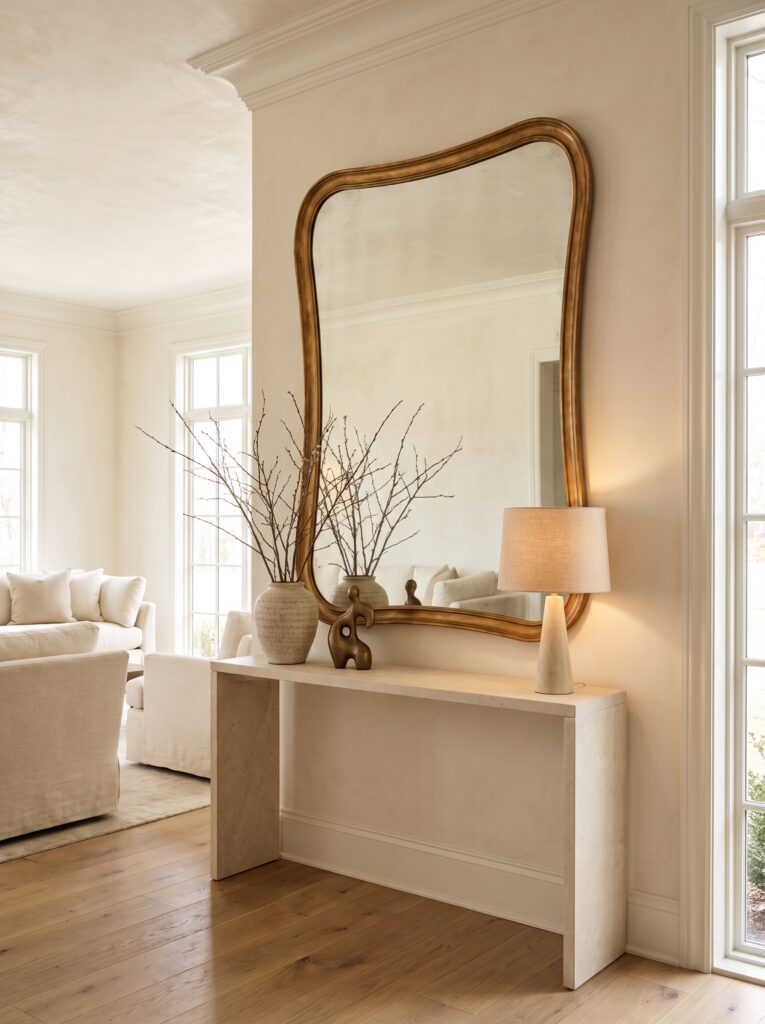
3. Add an Organic-Shaped Mirror
If you prefer a contemporary or organic modern interior, consider mirrors with irregular or softly sculptural silhouettes.
These mirrors do not necessarily have a perfect geometric shape.
Instead, they may feature asymmetrical edges, rounded corners, wavy outlines, or naturally inspired forms.
An organic-shaped mirror can become a piece of wall art while still providing the practical benefits of reflection.
Keep the surrounding decor relatively simple so the shape remains noticeable.
This approach works especially well with natural materials such as:
- Light oak
- Travertine
- Linen
- Stone
- Ceramic
- Rattan
- Plaster
- Bouclé
The combination creates a warm, contemporary atmosphere that feels sophisticated without looking overly formal.
4. Style a Mirror Above a Console Table
A console table and mirror are one of the most timeless combinations in home decorating.
The formula is simple:
Mirror + console + lighting + carefully selected accessories.
Start with a mirror that is appropriately scaled to the console.
Then add a lamp, vase, bowl, books, or sculptural object.
You do not need to use every accessory at once.
In fact, leaving some empty space can make the arrangement feel more expensive.
For a classic American interior, try a wood console with an antique-inspired mirror and brass table lamp.
For a modern interior, combine a slim console with an oversized organic mirror and minimal ceramic accessories.
For a transitional home, mix traditional framing with contemporary styling.
5. Create a Welcoming Entryway With a Mirror
The entryway sets the tone for the entire home.
A mirror is particularly useful here because it can make the entrance feel brighter and more spacious while providing a practical place for a final glance before leaving.
A round or arched mirror above an entryway console creates an elegant focal point.
You can complete the arrangement with a small lamp, decorative tray, vase, and a few natural branches.
If the entryway is narrow, choose a vertically oriented mirror.
If the wall is wider, a horizontal or oversized design may work better.
The goal is to balance the mirror with the dimensions of the wall and furniture.
6. Place a Mirror Opposite a Window
One of the most useful mirror-placement tricks is positioning a mirror where it can reflect natural light.
A mirror opposite or near a window can visually distribute daylight throughout the room.
This can be especially helpful in spaces that feel darker or more enclosed.
However, think carefully about what the mirror will reflect.
You do not want the reflection to emphasize clutter, an unattractive wall, or an awkward architectural feature.
Before installing the mirror, stand where it will be positioned and imagine the reflection from different angles.
The best mirror placement does not simply reflect light—it reflects something beautiful.
7. Use Mirrors to Brighten Dark Corners
Every home has areas that receive less natural light.
A hallway, corner, stair landing, or interior wall can sometimes feel darker than the rest of the house.
A decorative mirror can help visually open up that area.
Pair the mirror with a nearby wall sconce, table lamp, or picture light for an even stronger effect.
The combination of reflection and warm artificial lighting can make a previously overlooked corner feel intentional.
This is especially effective during the evening when natural daylight disappears.
8. Try a Vintage or Antique-Inspired Mirror
If you want your home to feel collected rather than newly decorated, vintage-inspired mirrors are an excellent option.
Look for details such as:
- Aged finishes
- Decorative frames
- Patina
- Ornamental edges
- Traditional silhouettes
- Distressed detailing
- Antique brass tones
A vintage mirror can introduce history and personality into an otherwise contemporary room.
You do not need an entirely traditional interior to use one.
In fact, pairing an antique-inspired mirror with modern furniture can create a beautiful contrast.
For example, place a vintage gold-toned mirror above a sleek contemporary console.
The result feels layered rather than overly coordinated.
9. Combine a Mirror With Architectural Molding
Architectural molding can make a room feel custom-built.
Picture-frame molding, wall paneling, wainscoting, and other decorative details can provide a beautiful backdrop for a mirror.
One approach is to center a large mirror inside a paneled wall.
Another option is to use a decorative mirror above a section of wainscoting.
The architectural detail gives the mirror a defined visual frame even when the mirror itself has a relatively simple design.
This combination works especially well in traditional, transitional, and classic American interiors.
10. Use a Mirror Above a Fireplace
A fireplace is naturally one of the most important architectural features in many homes.
Traditionally, artwork has often been placed above the mantel, but a large mirror can create an equally beautiful focal point.
A mirror above a fireplace can reflect light from lamps, windows, or the room itself.
For a classic look, consider a large rectangular mirror with a decorative frame.
For a contemporary home, try an oversized round or organically shaped mirror.
Keep the mantel styling restrained.
A few ceramics, candles, branches, or sculptural objects can complement the mirror without competing with it.
11. Create a Layered Mirror-and-Art Arrangement
Mirrors do not always have to stand alone.
You can combine a mirror with artwork and decorative objects to create a more collected wall.
For example, a large mirror can serve as the anchor while smaller framed artwork is positioned nearby.
This approach works particularly well in eclectic interiors.
The trick is to establish a visual relationship between the pieces.
Repeat a frame finish, color, shape, or material so the arrangement feels connected.
Avoid making everything identical.
A collected wall should have variation.
12. Use Round Mirrors to Create Visual Balance
Round mirrors are especially useful in rooms dominated by rectangular furniture.
Think about a bedroom with a rectangular headboard, nightstands, dresser, and windows.
Adding a large round mirror introduces an entirely different shape.
The same principle works in an entryway with a rectangular console.
The circle becomes a visual counterpoint.
Round mirrors are also naturally suited to minimalist interiors because their shape provides interest without requiring elaborate decoration.
A simple round mirror can sometimes be more effective than a heavily ornamented one.
13. Choose the Right Mirror Frame
The frame is just as important as the mirror itself.
A mirror with a beautiful frame can function as decorative artwork.
Wood Frames
Wood adds warmth and works beautifully with organic, rustic, Scandinavian, and transitional interiors.
Brass Frames
Brass creates a sophisticated appearance and pairs especially well with warm neutral interiors.
Black Frames
Black provides contrast and works beautifully in modern, industrial, and contemporary homes.
Antique Gold
Antique gold can introduce traditional elegance without looking overly shiny.
Frameless Mirrors
Frameless designs create a minimalist and contemporary appearance.
When choosing a frame, consider the other finishes already present in your room.
The mirror does not have to match everything perfectly, but it should feel connected to the overall design.
14. Use Mirrors in Small Apartments
Decorating a small apartment requires careful consideration of scale.
Mirrors can be especially valuable because they provide visual depth without taking up much physical space.
A large mirror can make a compact living room feel more open.
A mirrored cabinet can add functionality and reflection simultaneously.
A narrow vertical mirror can make a small hallway appear taller.
The key is to avoid using too many mirrors.
One or two strategically placed mirrors usually have more impact than covering every wall with reflective surfaces.
15. Add a Decorative Mirror to the Bedroom
Bedrooms benefit from mirrors because they can add softness and visual interest.
A large mirror above a dresser creates an elegant focal point.
A full-length mirror positioned near a closet can be both practical and decorative.
For a sophisticated bedroom, choose a frame that complements the bed, nightstands, and lighting.
A brass-framed mirror can work beautifully with warm wood furniture.
A simple black mirror can complement a modern neutral bedroom.
An organic mirror can soften a minimalist space.
16. Make a Bathroom Feel More Designed
Bathroom mirrors are obviously functional, but they can also become major design elements.
Instead of choosing a basic rectangular mirror, consider:
- Rounded mirrors
- Arched mirrors
- Fluted frames
- Brass-framed mirrors
- Oversized mirrors
- Sculptural shapes
For a more luxurious bathroom aesthetic, coordinate the mirror with the faucet, sconces, cabinet hardware, and other metal finishes.
If the bathroom features natural stone, wood cabinetry, and warm lighting, choose a mirror that complements those materials rather than fighting them.
17. Pair Mirrors With Wall Sconces
Lighting can make a mirror arrangement even more beautiful.
Wall sconces positioned on either side of a mirror create symmetry and provide flattering illumination.
This combination is especially popular in bathrooms, bedrooms, hallways, and entryways.
Choose sconces that relate to the style of the mirror.
A traditional mirror can pair beautifully with classic brass sconces.
A modern organic mirror may work better with simple sculptural fixtures.
Lighting should enhance the mirror rather than overwhelm it.
18. Avoid These Common Mirror Decorating Mistakes
Even a beautiful mirror can look awkward if it is poorly placed.
Choosing the Wrong Scale
A tiny mirror above a large console can feel disconnected.
Likewise, an enormous mirror can overwhelm a small piece of furniture.
Hanging It Too High
The mirror should visually connect with the furniture beneath it.
If there is a large gap between the furniture and mirror, the arrangement may feel disconnected.
Reflecting Clutter
Always consider what the mirror will reflect.
A beautiful mirror reflecting a messy countertop is not going to create the desired effect.
Using Too Many Mirrors
More reflection does not automatically mean more style.
Choose strategic locations instead.
Ignoring the Frame
The frame should be treated as part of the overall decorating scheme.
19. How to Make a Mirror Look More Expensive
You do not necessarily need an expensive designer mirror to create a luxurious effect.
Focus on presentation.
Choose an appropriately sized mirror.
Pair it with beautiful lighting.
Give it breathing room.
Use high-quality-looking surrounding materials such as natural wood, stone, linen, ceramics, or aged metals.
Keep the area around it uncluttered.
For example, a simple oversized mirror above a natural wood console with one beautiful ceramic vase and a warm table lamp can look far more sophisticated than a smaller mirror surrounded by dozens of accessories.
Luxury often comes from proportion and restraint rather than excess.
Decorative Mirror Ideas by Home Style
Modern
Choose clean-lined mirrors with black, chrome, or minimal frames.
Keep the surrounding decor simple.
Traditional
Look for decorative frames, antique-inspired finishes, and classic silhouettes.
Pair them with wood furniture, molding, and elegant lighting.
Transitional
Combine classic mirror shapes with contemporary furniture.
This creates a balanced look that feels timeless.
Organic Modern
Choose irregular, rounded, or natural-looking mirror shapes.
Pair them with wood, stone, linen, ceramics, and neutral colors.
Eclectic
Mix vintage mirrors with modern artwork, collected furniture, and unusual accessories.
The goal is personality rather than perfect coordination.
How to Choose the Right Mirror for Your Wall
Before buying a decorative mirror, consider five things:
1. Wall Size
Measure the wall first.
2. Furniture Width
If the mirror is being placed above furniture, consider the relationship between the two.
3. Ceiling Height
Tall rooms often benefit from vertically oriented mirrors.
4. Natural Light
Think about what the mirror will reflect.
5. Existing Finishes
Consider wood tones, hardware, lighting finishes, and architectural details already present in the room.
These simple considerations can prevent an expensive-looking design from becoming visually unbalanced.
The Most Important Mirror Styling Rule
A mirror should have a reason for being where it is.
Do not simply hang one on an empty wall because the wall feels blank.
Ask yourself:
What will this mirror reflect?
What does it add to the room?
Does its shape complement the furniture?
Does its frame support the overall design style?
Does it improve the light or sense of space?
When you answer these questions before installing the mirror, the final result will usually feel much more intentional.
Conclusion
Decorative mirrors are one of the easiest ways to make a home feel brighter, more spacious, and more thoughtfully designed. From oversized statement mirrors and elegant arched silhouettes to vintage-inspired frames and organic sculptural shapes, there are countless ways to incorporate mirrors into an interior.
The most successful mirror designs are not necessarily the most expensive or elaborate. They are the ones that work with the architecture, reflect something beautiful, complement the furniture, and create balance within the room.
If your home feels flat, dark, unfinished, or visually smaller than you would like, consider adding a thoughtfully chosen decorative mirror. A single well-positioned mirror can transform an overlooked wall into a sophisticated focal point—and sometimes that small decorating change is all a room needs to feel completely refreshed.
Save these decorative mirror ideas for your next home makeover and use them as inspiration when decorating your entryway, bedroom, living room, dining room, hallway, bathroom, or any other space that could benefit from more light, depth, and personality.
- Afrohemian Dining Room Ideas for a Warm, Collected and Sophisticated Home
- Warm Wood and Black Kitchen Ideas for a Timeless Designer Look
- Small Reading Nook Ideas That Turn Forgotten Corners Into a Cozy Luxury Retreat
- Curated Trinket Shelf Ideas: How to Create a Collected and Personal Home
- Neo Deco Entryway Ideas That Make Your Home Feel Instantly Expensive