
A staircase is one of the most noticeable architectural features in a multi-level home, yet it is often one of the most overlooked when decorating. Homeowners may spend considerable time choosing furniture, wall colors, lighting, and accessories for their main living spaces while leaving the staircase wall completely empty or decorating it as an afterthought.
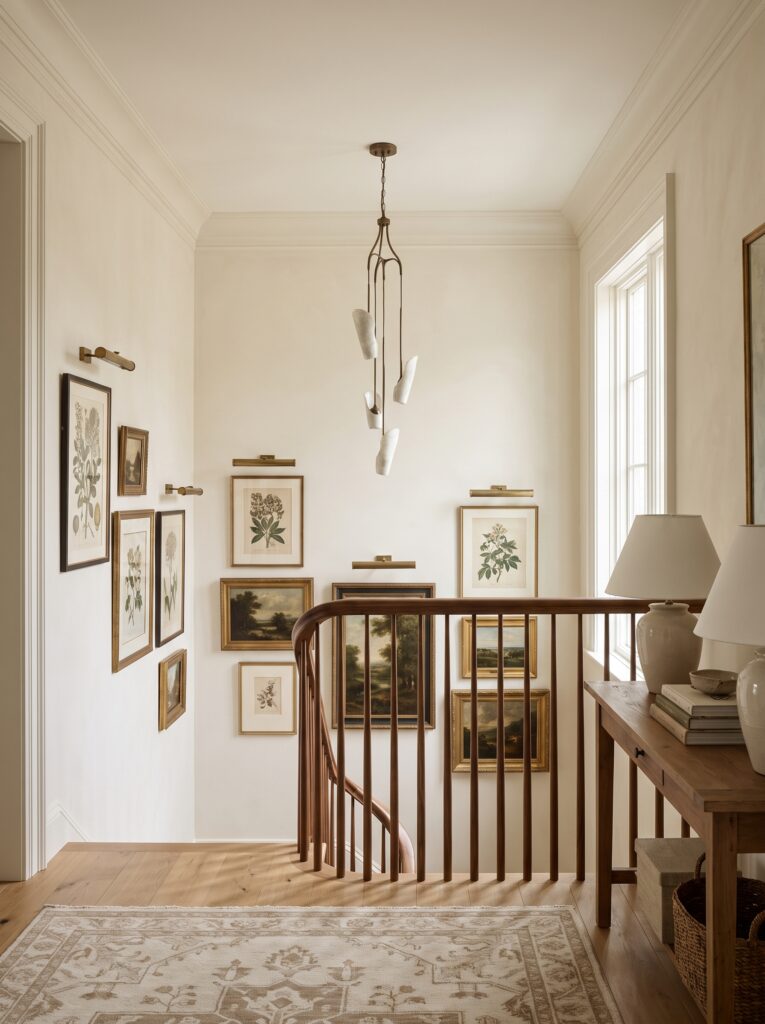
That is a missed opportunity.
A staircase can become one of the most beautiful visual moments in your home. With the right combination of artwork, lighting, architectural details, texture, and thoughtful styling, an ordinary staircase can feel intentional, sophisticated, and completely connected to the rest of the house.
The best staircase decor ideas do not necessarily involve filling the entire wall with decorations. In many cases, the most elegant approach is actually more restrained. A carefully curated gallery of artwork, a beautiful pendant light, a warm wood handrail, or a subtle runner can completely transform the atmosphere.
Whether your home is traditional, transitional, modern, contemporary, or somewhere in between, there are plenty of ways to make your staircase feel more polished without turning it into an overly decorated display.
Why Staircase Decor Matters
Staircases naturally attract attention because they connect different levels of a home. Their vertical structure also creates a large visual area that can influence how the surrounding hallway feels.
When a staircase is thoughtfully designed, it can:
- Make a hallway feel more finished
- Create a strong focal point
- Add personality to an otherwise plain wall
- Connect different areas of the home
- Highlight architectural features
- Make a smaller hallway feel more intentional
- Introduce artwork without overcrowding living spaces
- Improve the overall flow of the home’s interior
For homeowners who want an elevated interior without completely renovating their house, staircase decorating can be a surprisingly high-impact project.
The goal is not to make the staircase look expensive simply for the sake of appearance. Instead, think about creating a space that feels considered, cohesive, and personal.
1. Start With the Architecture
Before buying any staircase decorations, look at the structure itself.
Is the staircase:
- Straight?
- L-shaped?
- U-shaped?
- Open to the living room?
- Enclosed within a hallway?
- Narrow?
- Wide?
- Carpeted?
- Hardwood?
- Tiled?
The architecture should determine your decorating strategy.
A narrow staircase may benefit from a simpler gallery wall and one strong light fixture. A wide staircase can accommodate larger artwork, a substantial runner, or more architectural lighting.
If the staircase opens directly into a living area, it should also relate visually to the living room.
This does not mean everything needs to match.
Instead, repeat a few materials or colors so the spaces feel connected.
For example, if your living room has walnut furniture and aged brass lighting, introducing walnut frames and brass picture lights along the staircase can create subtle continuity.
2. Create a Curated Staircase Gallery Wall
A staircase gallery wall is one of the most classic ways to decorate a stairway.
However, there is a difference between a curated gallery wall and simply hanging as many frames as possible.
A sophisticated staircase gallery should feel intentional.
Choose artwork that shares at least one common element, such as:
- Similar color tones
- Matching frame finishes
- A consistent subject
- Similar artistic style
- Related proportions
You can still mix different frame sizes.
In fact, variation often makes a gallery wall more interesting.
Try combining:
- Large rectangular artwork
- Small portrait frames
- Vintage-inspired prints
- Abstract artwork
- Black-and-white photography
- Botanical illustrations
The key is to create visual rhythm rather than perfect uniformity.
3. Use Warm Wood Frames
If your staircase has neutral walls, warm wood frames can immediately make the space feel more inviting.
Walnut, oak, and medium-toned wood work particularly well with:
- Cream walls
- Beige carpeting
- Natural stone
- White oak floors
- Brass lighting
- Soft taupe textiles
Wood also prevents a gallery wall from feeling too cold.
For a transitional American home, a combination of warm wood frames and understated artwork can create a timeless appearance.
4. Don’t Hang Everything at the Same Height
A staircase follows a diagonal path, so the artwork should visually respond to that movement.
Rather than creating a perfectly horizontal line, arrange the artwork so that it naturally follows the staircase.
The center of each composition should generally feel connected to the movement of the stairs.
Before putting holes in the wall, lay your frames on the floor and experiment with the arrangement.
You can also use paper templates to test the placement.
This simple step can save considerable frustration.
5. Add Picture Lighting
Lighting is one of the easiest ways to make staircase artwork feel more sophisticated.
Small picture lights installed above selected frames can create a gallery-like atmosphere.
Consider finishes such as:
- Aged brass
- Antique brass
- Bronze
- Matte black
Warm lighting is generally more welcoming than extremely cool lighting.
Instead of illuminating every frame, you can highlight one or two important pieces.
This creates contrast and prevents the wall from feeling visually overloaded.
6. Choose One Large Artwork Instead
Not every staircase needs a gallery wall.
If you prefer minimalist interiors, one oversized piece of artwork can be much more effective.
A large abstract painting or oversized photographic print can become a dramatic focal point.
This approach works especially well on a broad staircase wall.
Choose something with colors that connect to the rest of your home.
For example:
Cream + charcoal + walnut
or
Taupe + olive + warm white
or
Muted terracotta + beige + brown
These palettes can feel sophisticated without overwhelming the architecture.
7. Use a Stair Runner for Texture
The wall is not the only part of a staircase that can be decorated.
A stair runner can introduce color, pattern, softness, and texture.
For an elegant home, consider:
- Natural wool
- Subtle geometric patterns
- Vintage-inspired runners
- Neutral stripes
- Soft botanical patterns
- Muted traditional motifs
A runner can also make a staircase feel warmer and more comfortable underfoot.
If the surrounding decor is already detailed, choose a quieter runner.
If the staircase itself is very plain, a more distinctive runner can become the focal point.
8. Combine a Runner With a Simple Wall
One common mistake is combining a highly patterned stair runner with an extremely busy gallery wall.
Both elements compete for attention.
Instead, let one feature dominate.
If you choose a bold vintage-inspired runner, keep the artwork relatively quiet.
If the gallery wall is the main statement, choose a simple neutral runner.
This principle helps maintain visual balance.
9. Make the Handrail Part of the Design
A staircase handrail can have a major effect on the overall appearance.
Warm walnut or oak handrails can make a staircase feel significantly more refined.
If your existing railing looks dated, updating the handrail may provide more impact than buying decorative accessories.
Depending on your home’s architecture, consider:
- Warm wood
- Painted wood
- Simple metal
- Mixed wood and metal
- Traditional turned details
- Clean modern profiles
The best option depends on the existing architecture.
A modern metal railing may look beautiful in a contemporary home but feel disconnected in a traditional colonial-style house.
10. Introduce an Architectural Light Fixture
If your staircase has a high ceiling or open stairwell, consider using a statement pendant or chandelier.
A vertically oriented staircase naturally creates an opportunity for dramatic lighting.
Possible styles include:
- Sculptural pendant lights
- Traditional chandeliers
- Linear hanging fixtures
- Lantern-style fixtures
- Clustered glass pendants
A warm metal finish can help connect the lighting to other fixtures throughout the house.
However, make sure the fixture is appropriately scaled for the staircase.
A tiny light can disappear in a large stairwell, while an oversized fixture can overwhelm a narrow staircase.
11. Keep the Color Palette Restrained
Staircases often connect several rooms, so they benefit from a flexible color palette.
Instead of introducing an entirely new color scheme, borrow colors from nearby spaces.
For example, if your home uses:
- Warm white
- Walnut
- Olive
- Aged brass
continue those colors along the staircase.
This creates continuity.
You can still introduce artwork with additional colors, but the overall environment should feel related to the rooms around it.
12. Try a Black-and-White Photography Gallery
Black-and-white photography is an excellent option if you want a staircase gallery that feels sophisticated and timeless.
Photographs can include:
- Architecture
- Landscapes
- City scenes
- Vintage portraits
- Botanical studies
- Travel photography
Use matching or coordinating frames for a more cohesive appearance.
Black frames with white mats create a classic gallery aesthetic.
Warm wood frames create a softer, more organic interpretation.
13. Use Botanical Artwork
Botanical prints can bring a subtle connection to nature without making the staircase feel overly decorative.
They work especially well with:
- Green cabinetry
- Natural wood
- Linen
- Woven materials
- Neutral walls
If your home already has plants or natural textures, botanical artwork can reinforce that theme.
Choose muted greens and earthy neutrals for a sophisticated appearance.
14. Create a Vintage-Inspired Staircase
If you love traditional or collected interiors, consider giving your staircase a vintage-inspired character.
You do not need authentic antiques for every piece.
Instead, combine:
- Vintage-style frames
- Antique-inspired brass lighting
- Traditional runner
- Old-world artwork
- Warm wood
- Decorative molding
The result can feel established and layered.
This is particularly effective in older American homes where the staircase already has architectural character.
15. Add Picture Molding
Picture molding can completely change a plain staircase wall.
Instead of relying solely on artwork, use architectural trim to create visual structure.
You can create:
- Rectangular panels
- Large framed sections
- Repeated molding patterns
Then place artwork inside selected sections.
This approach is particularly beautiful in traditional and transitional interiors.
It can make a relatively simple staircase feel much more custom.
16. Use Wall Sconces
If your staircase has enough wall space, sconces can provide both function and decoration.
A pair of sconces can frame artwork or architectural molding.
Choose finishes that coordinate with the rest of your home’s lighting.
For a timeless look:
Aged brass + cream walls + warm wood
is difficult to go wrong with.
For a more contemporary aesthetic:
Matte black + warm white + natural oak
can create a cleaner appearance.
17. Don’t Ignore the Landing
The staircase landing is another opportunity for styling.
If you have a small landing at the top or bottom of the stairs, consider adding a single decorative moment.
Depending on the available space, this could be:
- A small console
- A narrow bench
- A large artwork
- A sculptural vase
- A mirror
- A small table lamp
However, never sacrifice walking space for decoration.
The landing should remain functional and safe.
18. Use a Mirror Carefully
Mirrors can make a hallway feel brighter and more spacious.
A large mirror can also reflect natural light from nearby windows.
For an elegant staircase, consider:
- Arched mirrors
- Antique-style mirrors
- Simple rectangular mirrors
- Thin-framed mirrors
A mirror with an aged or slightly imperfect finish can add character.
If your staircase already has a large gallery wall, however, a mirror may be unnecessary.
Again, restraint matters.
19. Consider a Tone-on-Tone Look
If you prefer minimalist decor, a tone-on-tone staircase can be beautiful.
Imagine:
Warm white wall + ivory artwork + cream runner + light oak handrail
The effect is subtle but sophisticated.
Texture becomes more important when color contrast is low.
Use:
- Linen
- Wool
- Wood
- Plaster
- Ceramic
- Brushed metal
to create depth.
20. Create a Modern Organic Staircase
Modern organic interiors continue to appeal to homeowners who want spaces that feel contemporary but comfortable.
For a staircase, combine:
- Natural oak
- Soft cream walls
- Organic artwork
- Textured runner
- Sculptural lighting
- Woven accents
Avoid excessive decoration.
The beauty of this style comes from natural materials and simple forms.
21. How to Decorate a Narrow Staircase
A narrow staircase requires a slightly different strategy.
Avoid large furniture and excessive wall accessories.
Instead, focus on:
- Vertical artwork
- Slim frames
- Light colors
- Simple lighting
- A narrow runner
- Reflective surfaces
A gallery wall can still work, but smaller frames and controlled spacing are generally more successful.
Keeping the walls lighter can also prevent the staircase from feeling enclosed.
22. How to Decorate an Open Staircase
Open staircases offer more opportunities because they often interact directly with the living room or entryway.
In this situation, think of the staircase as part of the larger room.
Repeat materials from the nearby furniture.
For example:
Living room walnut furniture → walnut staircase handrail
Brass lighting → brass picture lights
Cream upholstery → cream runner
These repeated details create a cohesive design language.
23. What Makes a Staircase Look Expensive?
Luxury is often about proportion and restraint rather than the number of decorative items.
A staircase can feel elevated when it includes:
- Properly scaled artwork
- Quality frames
- Warm architectural lighting
- Natural materials
- A well-fitted runner
- Consistent finishes
- Clean lines
- Thoughtful spacing
Avoid filling the staircase with inexpensive-looking decorations simply because the wall is empty.
One beautifully chosen artwork can have more impact than ten random accessories.
24. Budget-Friendly Staircase Updates
You do not need to remodel the entire staircase.
Start with small changes.
Paint
A fresh warm neutral can completely change the appearance.
Artwork
Thrifted or printable artwork can create a gallery wall without a huge investment.
Frames
Updating mismatched frames can instantly make existing artwork feel more cohesive.
Lighting
Replacing dated fixtures can have a surprisingly dramatic effect.
Handrail
A new wood handrail can provide a major architectural update.
Runner
A new stair runner can introduce texture and color.
Choose one project at a time instead of attempting everything simultaneously.
25. Staircase Decor Mistakes to Avoid
Overcrowding the Walls
Empty space is not automatically a problem.
Using Too Many Frame Styles
A little variation is good, but excessive variation can look chaotic.
Ignoring Scale
Tiny artwork on a huge wall can look accidental.
Forgetting Lighting
Beautiful artwork can disappear without adequate illumination.
Choosing Trendy Pieces Without Considering the Home
Your staircase should feel connected to the architecture.
Blocking the Walking Area
Safety should always come before decoration.
Making Everything Match
A staircase should coordinate with your home—not look like a furniture showroom.
26. A Simple Formula for an Elegant Staircase
If you are unsure where to begin, use this formula:
1 architectural feature + 1 artwork strategy + 1 texture + 1 lighting element
For example:
Warm wood handrail + curated gallery wall + wool runner + aged brass picture lights
Or:
White paneled wall + oversized artwork + natural oak steps + sculptural pendant
This gives the staircase enough visual interest without making it feel crowded.
27. How to Make Your Staircase Feel Connected to the Rest of Your Home
The staircase should not feel like a separate decorating project.
Look at the rooms surrounding it.
Choose two or three elements to repeat.
If your living room has:
- Walnut
- Cream
- Olive
you could use walnut frames, cream walls, and muted green artwork on the staircase.
If your entryway features:
- Black
- Brass
- Natural wood
bring those materials into the stairway.
This subtle repetition creates a much more sophisticated home.
28. Staircase Decor for the Fall Season
If you want a seasonal update, keep it subtle.
Rather than covering the staircase with obvious autumn decorations, introduce fall through:
- Dried branches
- Warm artwork
- Burgundy accents
- Rust-colored textiles
- Warm lighting
- Natural wood
- Small ceramic objects
This allows the staircase to feel seasonal without needing to be completely redecorated.
29. Staircase Decor That Works All Year
For truly evergreen styling, choose elements that do not depend on a particular season.
A neutral gallery wall, quality runner, natural wood handrail, and warm lighting can work throughout the year.
Then change only small accessories when the seasons change.
This approach is particularly useful for homeowners who want a beautiful home without constantly buying new decorations.
Conclusion
A staircase may be a functional part of your home, but it does not have to look purely functional. With thoughtful decorating, it can become an architectural feature that adds personality, warmth, and sophistication to the entire interior.
The best staircase decor ideas begin with the structure of the home itself. Rather than forcing a trend onto the space, consider the staircase’s proportions, lighting, materials, and relationship to the rooms around it.
A curated gallery wall can bring personality. A warm wood handrail can add architectural richness. A wool runner can introduce softness. Aged brass picture lights can highlight artwork. A sculptural pendant can transform an open stairwell into a dramatic focal point.
And you do not need to use all of these ideas at once.
Sometimes the most successful staircase is the simplest one—a beautiful wall, a few carefully selected pieces of artwork, warm lighting, and enough empty space to allow everything to breathe.
If you are refreshing your home this year, do not overlook the staircase. It is one of those areas where a relatively small decorating investment can create a surprisingly large visual difference.
The goal is not simply to decorate the stairs.
The goal is to make the transition between different areas of your home feel intentional, beautiful, and completely connected to the way you live.
- Vintage Bathroom Vanity Ideas: How to Create an Elegant and Timeless Bathroom
- Small Balcony Makeover Ideas: How to Turn a Tiny Balcony Into a Cozy Autumn Retreat
- Elegant Fall Dining Table Decor: Sophisticated Autumn Tablescape Ideas for a Warm Home
- Elegant Mudroom Ideas: How to Create a Beautiful, Organized and Welcoming Drop Zone
- Dark Cottagecore Kitchen Ideas: How to Create a Moody, Warm and Timeless Kitchen