
The space underneath a staircase is one of those areas that is easy to ignore. It may be too small for conventional furniture, too awkward for a standard closet, and too valuable to simply leave empty.
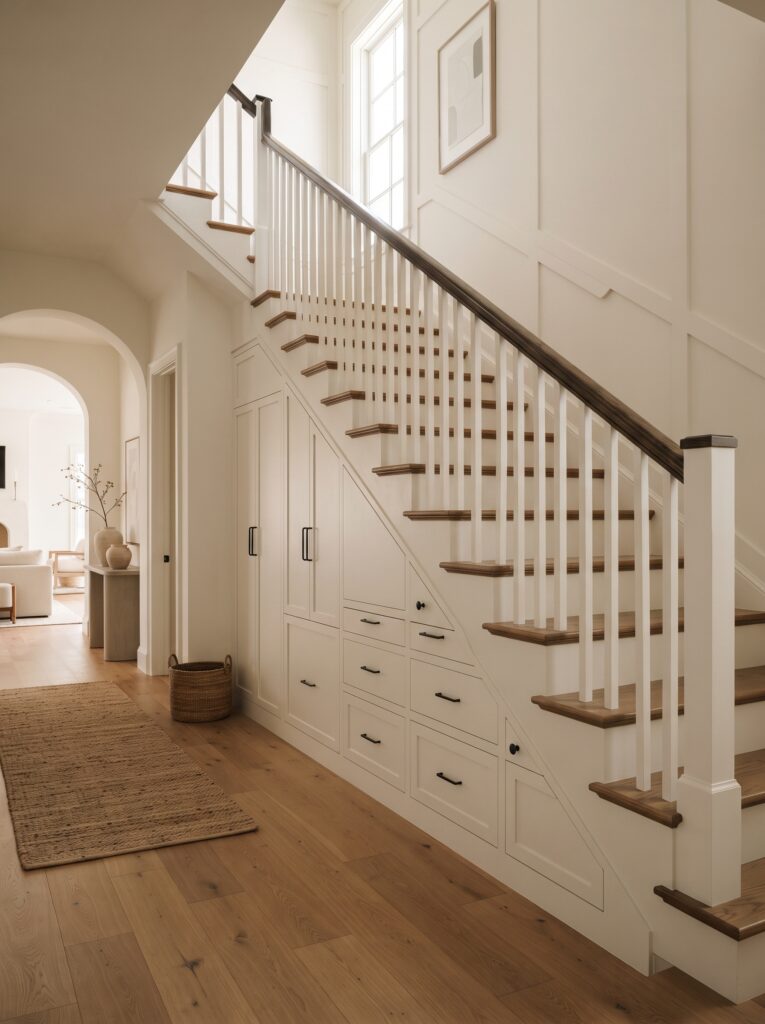
But with thoughtful planning, that forgotten area can become some of the most useful storage in your home.
Under-stair storage is especially valuable in American homes where homeowners are looking for ways to make better use of every square foot without making their interiors feel cluttered. Instead of adding another freestanding cabinet or bulky storage unit, the space beneath the stairs can be transformed into drawers, cabinets, shelves, a hidden closet, or even a combination of several storage solutions.
The most successful designs do not make the storage look like an afterthought. They make it feel like part of the home’s original architecture.
Why Under-Stair Storage Is Worth Considering
A staircase already takes up a significant amount of floor area.
The space underneath it is therefore an opportunity to create storage without sacrificing another part of the room.
Depending on the staircase design, you might be able to use the area for:
- Shoes
- Coats
- Cleaning supplies
- Household essentials
- Books
- Toys
- Linens
- Seasonal decorations
- Pet supplies
- Bags
- Office supplies
- Pantry overflow
- Everyday clutter
The exact solution depends on the location and dimensions of the staircase.
A staircase near an entrance might benefit from coat and shoe storage, while one beside a kitchen could become additional pantry storage.
The Best Under-Stair Storage Starts With the Location
Before deciding what type of cabinetry you want, consider where the staircase is located.
Near the Front Entrance
An under-stair area near an entry can become a convenient drop zone.
You can create designated storage for:
- Shoes
- Handbags
- Jackets
- Umbrellas
- Keys
- Everyday accessories
Closed cabinetry is particularly useful if you want the space to look visually calm.
Near the Kitchen
A staircase close to the kitchen can provide additional food and household storage.
Depending on the available space, you might create:
- Pull-out pantry cabinets
- Appliance storage
- Small shelves
- Beverage storage
- Household supply cabinets
The important thing is to avoid creating a storage system that interrupts the kitchen’s circulation.
Near a Living Space
When the staircase is adjacent to a living area, the storage can be used for less visually obvious items.
Books, games, blankets, electronics, and miscellaneous household objects can all disappear behind closed doors.
Built-In Drawers
One of the most practical under-stair storage ideas is a series of built-in drawers.
The drawers can follow the angle of the staircase, allowing you to use different depths according to the available space.
This is particularly useful because deep open shelves can quickly become difficult to organize.
Drawers allow you to separate categories.
For example:
Drawer 1: everyday shoes
Drawer 2: accessories
Drawer 3: pet supplies
Drawer 4: household items
Instead of searching through one large storage compartment, everything has a designated place.
Pull-Out Cabinets
Pull-out cabinets are another excellent solution for narrow spaces.
They can be designed to slide outward like a pantry.
This makes deep areas easier to access because you can bring the entire storage compartment toward you.
Pull-out systems are especially useful for:
- Cleaning products
- Tall bottles
- Wrapping supplies
- Pantry items
- Small appliances
- Household tools
Because the cabinets can be closed, they also help maintain a clean visual appearance.
Closed Cabinetry for a Minimalist Look
If your priority is a clean and sophisticated interior, closed cabinetry is often the simplest approach.
Instead of displaying everything, create seamless doors that blend with the surrounding wall.
For a timeless American interior, consider:
- Warm white cabinetry
- Soft beige
- Natural oak
- Walnut
- Mushroom
- Muted gray-green
Choose hardware that complements the rest of the home.
The result should look like custom millwork rather than a collection of storage boxes.
Open Shelving for Books and Decor
Not every under-stair space needs to be hidden.
If the area is located in a living room or hallway, open shelving can create an attractive display.
Use it for:
- Books
- Ceramics
- Framed photographs
- Small artwork
- Baskets
- Plants
- Collected objects
However, open shelves work best when there is a balance between display and empty space.
Avoid filling every shelf.
A few carefully chosen objects often look more sophisticated than a completely packed arrangement.
A Hidden Under-Stair Closet
Sometimes the best storage solution is the least visible one.
A small door can conceal an entire storage closet beneath the staircase.
This can be useful for:
- Vacuum cleaners
- Brooms
- Mops
- Cleaning supplies
- Luggage
- Seasonal decorations
- Extra household products
If the door is painted the same color as the surrounding wall, it can almost disappear.
This is particularly useful in minimalist homes where visible storage may make the space feel busy.
Under-Stair Shoe Storage
If your staircase is close to an entrance, shoe storage can be one of the most practical uses.
Instead of a large shoe rack sitting in the hallway, build shallow drawers or cabinets into the staircase.
You can create separate compartments for different types of footwear.
For a family home, labeled sections can make the system even easier to maintain.
The key is ventilation and easy cleaning, especially when storing everyday shoes.
Creating a Small Home Office
Depending on the height and depth available, the space beneath a staircase can sometimes become a compact workspace.
A slim desk can fit into the taller section while shelves use the vertical wall space.
This can work particularly well for:
- Laptop work
- Paying bills
- Homework
- Journaling
- Household administration
- Occasional remote work
The workspace should be carefully measured before installation.
You need enough head clearance to use it comfortably, and electrical access should be planned before the cabinetry is built.
Under-Stair Reading Space
A staircase with enough height and depth can also create a cozy reading corner.
Add:
- A compact upholstered chair
- Wall-mounted lighting
- A small side table
- A narrow bookshelf
Keep the furniture appropriately scaled.
The goal is to work with the existing architecture rather than forcing a full-size seating arrangement into a small space.
Pet Storage
Another clever use is dedicated pet storage.
The cabinetry can hold:
- Leashes
- Toys
- Food
- Grooming supplies
- Towels
- Pet accessories
If your staircase is near an entrance, this can be particularly convenient.
You can even create a small washable zone underneath the staircase if the dimensions and construction allow it.
Children’s Storage
Families can also use under-stair cabinetry to organize children’s belongings.
Create low-access drawers for:
- Toys
- Books
- Crafts
- Games
- School supplies
Closed storage is especially helpful because it allows you to quickly hide clutter before guests arrive.
Use durable finishes and rounded or appropriate hardware where children will frequently interact with the cabinetry.
Seasonal Storage
The space underneath stairs can be ideal for items that are not needed every day.
Think about:
- Holiday decorations
- Extra blankets
- Winter accessories
- Seasonal tableware
- Gift-wrapping supplies
- Travel accessories
Use labeled containers so seasonal storage does not become a hidden version of clutter.
A good organizational system should make things easier to retrieve—not simply give clutter somewhere else to live.
Make the Cabinetry Look Architectural
This is where a basic storage project can become a beautiful design feature.
Rather than installing generic cabinets, consider designing the storage around the staircase itself.
The cabinetry can:
- Follow the stair angle
- Match existing trim
- Continue the baseboard
- Use coordinated paint
- Repeat existing wood finishes
- Integrate with nearby millwork
When these details are handled well, the storage feels like it belongs to the house.
Choosing Materials
The right material depends on your budget and the amount of use the storage will receive.
Painted MDF
MDF is often useful for painted cabinetry and decorative millwork.
It can provide a smooth finish when properly prepared and painted.
Natural Wood
Oak and walnut can add warmth and character.
Natural wood is particularly beautiful in homes that already feature wood floors or cabinetry.
Plywood
Quality plywood can be useful for cabinet construction where durability is important.
Mixed Materials
Combining painted cabinetry with natural wood shelves can create a more layered appearance.
For example, warm white doors with walnut interiors can look sophisticated without becoming overly formal.
Hardware Makes a Difference
Cabinet hardware may seem like a small detail, but it can influence the overall appearance.
For a modern look, consider simple pulls or minimal handles.
For a transitional interior, aged brass or understated bronze can add warmth.
For a minimalist appearance, integrated pulls or push-to-open doors can reduce visual clutter.
The hardware should coordinate with other finishes in the room rather than introducing an unrelated metal.
Lighting the Under-Stair Area
Storage beneath stairs can sometimes become dark.
If you are designing the space from scratch, consider adding appropriate lighting.
Options may include:
- Recessed lighting
- Small wall sconces
- Integrated cabinet lighting
- Motion-activated interior lights
- Under-shelf lighting
Lighting makes the storage easier to use and can also make open shelving more attractive.
Electrical work should be planned appropriately and handled by a qualified professional where required.
Small Under-Stair Spaces Can Still Be Useful
You do not need a huge staircase cavity to benefit from this idea.
Even a shallow space can accommodate:
- Slim drawers
- Small cabinets
- Floating shelves
- Shoe storage
- Pet supplies
- Cleaning products
The trick is to match the storage type to the dimensions.
A narrow area should not be forced into a deep cabinet design.
Instead, use the available depth intelligently.
How to Keep Under-Stair Storage From Looking Cluttered
Storage works best when it has a visual strategy.
Choose one consistent finish.
Use similar containers where possible.
Avoid displaying too many unrelated objects.
For open shelves, leave some empty space.
For closed cabinetry, use internal organizers so everything has a designated location.
The outside should feel calm even if the storage is working hard on the inside.
Under-Stair Storage on a Budget
Custom cabinetry can become expensive, but there are ways to create a similar concept at different price points.
Start With One Section
Instead of renovating the entire staircase, focus on the most useful portion.
Use Ready-Made Components
In some situations, modular storage pieces can be adapted to fit part of the available space.
Add Simple Doors
Even basic shelving can look significantly more polished when concealed behind properly fitted doors.
Upgrade the Hardware
If the cabinetry is simple, attractive hardware can make it feel more intentional.
Paint Everything Consistently
A unified paint color can help separate pieces feel like one integrated installation.
Planning Before You Build
Before beginning an under-stair storage project, carefully evaluate the space.
Measure:
- Maximum height
- Minimum height
- Width
- Depth
- Stair angle
- Existing electrical components
- Plumbing
- HVAC components
- Access panels
- Structural elements
Never assume an empty-looking cavity is completely available for modification.
A staircase is part of the home’s structure, so structural changes should be properly evaluated by an appropriate professional.
Mistakes to Avoid
Sacrificing Accessibility
Beautiful storage is not useful if you cannot comfortably reach it.
Making Drawers Too Deep
Extremely deep drawers can become difficult to organize.
Ignoring Ventilation
Some stored items may require airflow.
Forgetting Electrical Access
Do not cover important electrical or mechanical components without proper planning.
Using Too Many Different Finishes
A complicated combination of colors and materials can make the staircase feel visually busy.
Treating It Like an Afterthought
The best results come from designing the storage as part of the room.
How to Make Under-Stair Storage Look Expensive
A luxury appearance usually comes from small details.
Keep the lines clean.
Use consistent spacing.
Choose quality-looking hardware.
Coordinate the cabinetry with the existing architecture.
Use warm, timeless materials.
Avoid excessive decoration.
And most importantly, make sure everything is proportional.
Even relatively simple cabinetry can look custom when it fits the staircase perfectly.
Conclusion
Under-stair storage is one of those home improvements that combines beauty with genuine practicality. Instead of allowing an awkward architectural space to remain unused, you can transform it into drawers, cabinetry, shelving, a hidden closet, a compact workspace, or a dedicated organization zone.
The best solution depends on the location of your staircase and the way your household actually uses the space.
A staircase near the entrance might benefit from shoe and coat storage. A staircase near the kitchen could provide additional pantry capacity. A living-area staircase might work beautifully with bookshelves or concealed household storage.
Whatever direction you choose, focus on function first and appearance second—then bring the two together through thoughtful materials, consistent finishes, good proportions, and carefully planned details.
When done well, under-stair storage does more than hide clutter. It makes the home work harder without making the home look busier. And that is what makes this small architectural space such a valuable opportunity for a more organized, functional, and beautifully designed home.
- Outdoor Fire Pit Ideas: How to Create a Cozy Backyard Lounge for Fall Evenings
- Bedroom Lighting Ideas: How to Create a Soft, Cozy, Luxury Bedroom at Home
- Under-Stair Storage Ideas: Smart Ways to Turn an Awkward Space Into Beautiful Home Storage
- Wall Paneling Ideas: How to Make a Plain Room Look Custom-Designed
- Color Drenching: The Designer-Inspired Home Decor Trend That Makes a Room Feel Rich and Intentional