
A bookshelf can be much more than a practical place to store books. When thoughtfully styled, it can become one of the most beautiful decorative features in your home, adding personality, warmth, texture, and visual interest to an otherwise empty wall. Whether you have built-in shelving, a freestanding bookcase, floating shelves, or a small apartment bookshelf, the right arrangement can make the entire room feel more intentional.
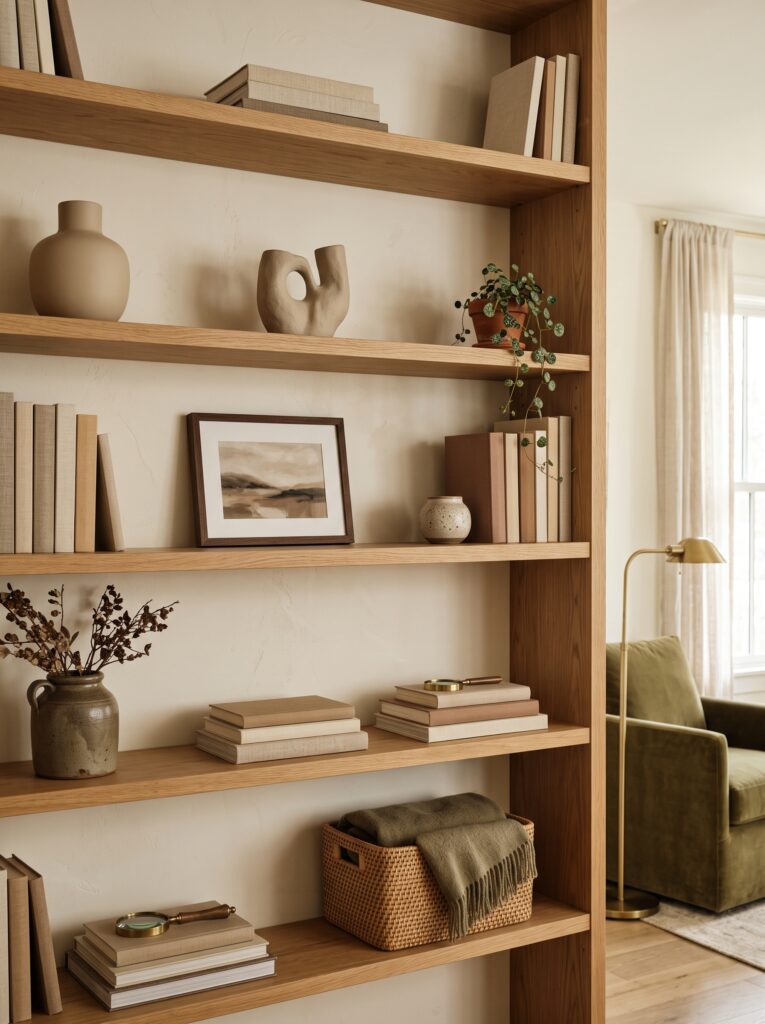
One of the biggest trends in modern American home decor is the curated bookshelf look—a style that feels collected, personal, and sophisticated rather than overly decorated. Instead of filling every shelf with matching accessories, designers often combine books, ceramics, framed artwork, natural materials, baskets, plants, and meaningful objects while leaving some intentional empty space.
If you’re searching for bookshelf styling ideas, shelf decor ideas, living room shelving inspiration, or elegant home decor, these techniques can help you create a bookshelf that looks beautiful without feeling cluttered.
Why Bookshelf Styling Can Transform a Room
A large bookshelf naturally draws attention because of its height and repetition. If every shelf is filled randomly, however, it can quickly become visually overwhelming.
Thoughtful styling creates rhythm and balance.
A well-designed bookshelf can:
- Add personality to a room
- Display favorite books
- Introduce color and texture
- Create visual height
- Fill an empty wall
- Showcase meaningful objects
- Make a room feel more sophisticated
- Add warmth to minimalist interiors
The goal isn’t to make the bookshelf look like a furniture showroom.
Instead, you want it to look as though the collection has developed naturally over time.
1. Begin With a Complete Bookshelf Reset
Before styling your shelves, remove everything.
This may seem unnecessary, but it allows you to see the structure of the bookshelf without visual distractions.
Create separate groups for:
Books you want to display
Books you want to store elsewhere
Decorative objects
Sentimental pieces
Items you no longer want
Don’t feel obligated to put everything back.
One of the easiest ways to create an elegant bookshelf is simply to reduce the number of objects.
2. Mix Horizontal and Vertical Books
One of the simplest bookshelf styling tricks is changing the direction of your books.
Instead of standing every book vertically, create small stacks of books horizontally.
For example:
Vertical books + horizontal stack + ceramic object
This creates variation and prevents the shelves from looking repetitive.
Horizontal stacks can also create platforms for decorative objects.
Place a small sculpture, candleholder, or ceramic piece on top of a stack.
This gives the object additional height without requiring a larger accessory.
3. Use Books as Decorative Color
Books can contribute to the overall color palette of your room.
If you prefer a neutral interior, choose books with:
- Cream covers
- Beige covers
- Warm brown covers
- Soft gray covers
- Muted green covers
- Black-and-white covers
You don’t necessarily need to remove every colorful book.
A few carefully placed colorful spines can add personality and prevent the bookshelf from feeling too coordinated.
The goal is visual balance rather than perfect color matching.
4. Add Ceramic Objects
Ceramics are excellent for bookshelf styling because they add shape and texture.
Try incorporating:
- Sculptural vases
- Small bowls
- Handmade pottery
- Organic-shaped vessels
- Ceramic candleholders
- Decorative figurines
Choose different sizes and shapes.
If every object has the same height, the shelf can feel flat.
Instead, combine tall, medium, and low objects.
5. Create Breathing Room
One of the most important rules of elegant bookshelf styling is negative space.
You don’t need to fill every available inch.
Leaving an empty section between two arrangements allows each grouping to stand out.
Empty space also makes the entire bookshelf feel lighter.
This is especially important when styling large built-in bookshelves.
A completely full bookshelf can visually dominate the room.
A carefully edited bookshelf feels calmer and more sophisticated.
6. Add Framed Artwork
Small pieces of artwork can make a bookshelf feel more personal.
Instead of hanging every artwork on the wall, try casually leaning a small frame against the back of a shelf.
Good options include:
- Botanical prints
- Abstract artwork
- Vintage illustrations
- Landscape photography
- Line drawings
- Architectural sketches
Layer a smaller frame in front of a larger one for added depth.
This creates a relaxed, collected appearance.
7. Bring in Natural Greenery
Plants are an easy way to soften a bookshelf.
A trailing plant can be especially beautiful when placed on an upper shelf.
Smaller plants can work on middle shelves.
You can also use a simple branch in a ceramic vase.
Good choices for a bookshelf include:
- Pothos
- Small ferns
- Olive branches
- Eucalyptus
- Trailing greenery
- Small sculptural plants
Don’t use plants on every shelf.
One or two strategically placed natural elements are usually enough.
8. Introduce Woven Baskets
Baskets are particularly useful when your bookshelf needs to combine storage with decoration.
A woven basket can hide:
- Blankets
- Magazines
- Toys
- Small electronics
- Extra household items
Natural baskets also introduce texture.
For an organic-modern or relaxed American home, materials such as rattan, seagrass, cane, and woven fibers can work beautifully.
Choose baskets that fit comfortably within the shelving unit without appearing squeezed into the space.
9. Use the Rule of Three
When creating small decorative arrangements, grouping objects in threes can create a natural sense of balance.
For example:
Stack of books + ceramic vase + small frame
or:
Sculpture + bowl + greenery
Different shapes and heights make the arrangement more interesting.
You don’t have to follow this rule on every shelf.
Use it as a starting point when you’re unsure how to group objects.
10. Vary the Height of Your Objects
A bookshelf can look monotonous when everything sits at the same height.
Instead, create layers.
Use:
- Tall vases
- Medium-sized books
- Low bowls
- Small sculptures
- Stacked books
- Framed artwork
This creates movement across the shelves.
If one shelf has a tall vase, the shelf next to it might feature a horizontal book stack instead.
Avoid making every shelf look identical.
11. Repeat Materials Throughout the Shelves
Although the objects should vary, repeating certain materials can create cohesion.
For example, if you use natural wood, ceramic, and woven materials on one shelf, repeat those materials elsewhere.
This makes the entire bookshelf feel connected.
The same principle works with colors.
If you use muted green on one shelf, repeat a small amount of green somewhere else.
This creates subtle visual continuity.
12. Create an Organic Modern Bookshelf
Organic-modern interiors are especially well suited to curated bookshelf styling.
Use:
- Natural wood
- Cream ceramics
- Neutral books
- Stone objects
- Woven baskets
- Greenery
- Linen textures
Keep the color palette soft.
Avoid excessive shiny accessories.
The result should feel warm, relaxed, and sophisticated.
13. Try a Minimalist Bookshelf
Minimalist shelf styling is about restraint.
Instead of placing several objects on every shelf, choose only the pieces that have visual or personal value.
You might use:
Books + one sculpture
or:
Books + one ceramic vase
or:
Artwork + small stack of books
This approach works particularly well in modern apartments and contemporary homes.
14. Style Built-In Shelves Around the Fireplace
Built-in bookshelves surrounding a fireplace create a natural architectural focal point.
When styling them, remember that the fireplace itself is already visually strong.
Avoid filling the shelves with excessive decoration.
Instead, create balanced compositions on both sides while allowing some differences between the left and right shelves.
Perfect symmetry can feel overly formal.
Subtle asymmetry often looks more natural.
15. Use the Bottom Shelves for Practical Storage
The lower sections of a bookshelf are often ideal for heavier or larger items.
Use them for:
- Baskets
- Large books
- Storage boxes
- Decorative boxes
- Oversized objects
This creates a visual progression from heavier elements at the bottom to lighter decorative objects toward the top.
It also keeps practical storage within easy reach.
16. Make the Top Shelf Count
The top shelf can be difficult to style because it is usually the highest visual point.
A single tall object can work beautifully here.
Consider:
- A tall ceramic vase
- Large branches
- Sculptural artwork
- A substantial basket
- A decorative object with vertical height
Don’t overcrowd the top shelf.
One strong piece can be more effective than several small accessories.
17. Incorporate Sentimental Objects
A beautiful bookshelf shouldn’t only contain things that look good.
Include objects that mean something to you.
This could be:
- Travel souvenirs
- Family photographs
- Vintage finds
- Handmade objects
- Heirlooms
- Favorite books
- Artwork created by someone you love
These pieces make your home feel personal.
A curated home isn’t necessarily one filled with expensive objects. It’s one that reflects the people who live there.
18. Create a Vintage-Modern Mix
Mixing old and new pieces can make a bookshelf feel more sophisticated.
Pair modern ceramic objects with vintage books.
Place contemporary artwork beside an antique-inspired frame.
Combine a new woven basket with a vintage decorative object.
This contrast prevents the bookshelf from feeling like everything was purchased at the same time.
19. Style a Small Bookshelf
Small bookcases require careful editing.
Instead of trying to use every shelf, prioritize the pieces you love most.
Use fewer objects but vary their heights.
A small bookshelf can look beautiful with:
- Several books
- One framed artwork
- One ceramic vessel
- One small plant
- One basket
Keep the arrangement light.
20. Use Lighting to Highlight Your Shelves
Lighting can take bookshelf styling to another level.
If possible, consider:
- Integrated shelf lighting
- Small picture lights
- Warm LED strips
- Directional spotlights
Warm lighting can highlight books, ceramics, artwork, and natural materials beautifully.
Avoid overly bright lighting that makes the shelves feel harsh.
Soft illumination creates a more sophisticated atmosphere, especially in the evening.
Bookshelf Styling Ideas for Different Rooms
Your bookshelf doesn’t have to be limited to the living room.
Living Room
Focus on books, artwork, ceramics, greenery, and meaningful decorative objects.
Home Office
Combine books with practical storage, framed artwork, baskets, and small plants.
Bedroom
Keep the styling softer and more minimal.
Use books, candles, ceramics, and calming artwork.
Dining Room
Display cookbooks, serving pieces, ceramics, and decorative vessels.
Entryway
Use a smaller bookcase or console-style shelving for baskets, artwork, and a few curated accessories.
How to Make a Bookshelf Look Expensive
You don’t need expensive decor to create a designer-inspired bookshelf.
Focus on:
Scale
Large objects should be balanced with smaller pieces.
Texture
Combine wood, ceramic, glass, woven materials, and stone.
Negative Space
Don’t fill every shelf.
Color
Use a cohesive palette.
Variation
Mix books, artwork, plants, and accessories.
Personalization
Include meaningful objects.
A bookshelf looks expensive when it feels intentional rather than when every item is expensive.
Bookshelf Styling Mistakes to Avoid
Filling Every Shelf
Empty space creates visual breathing room.
Making Every Shelf Identical
Variation creates a more natural composition.
Using Only Small Objects
Larger objects help anchor the design.
Matching Everything
A curated look requires some variation.
Too Many Colors
A controlled palette makes the arrangement more cohesive.
Ignoring Function
Your bookshelf should still be practical and accessible.
Using Too Much Decor
Sometimes removing three objects improves the entire arrangement.
Conclusion
Beautiful bookshelf styling is ultimately about creating a balance between function, personality, texture, and negative space. Your shelves should not look like a collection of random decorations placed wherever there was room. Instead, each section should feel intentionally composed while still maintaining the relaxed character of a real home.
Start by removing unnecessary items and keeping only the books and objects you genuinely enjoy. Then introduce different heights, textures, and shapes. Mix vertical books with horizontal stacks, add a few ceramic pieces, incorporate natural greenery, lean artwork against the shelves, and use baskets where practical storage is needed.
For homeowners searching for bookshelf styling ideas, shelf decor ideas, built-in bookshelf inspiration, living room shelving ideas, modern home decor, and curated interior design, the most timeless approach is to focus on thoughtful editing rather than excessive decoration.
The finished bookshelf should feel collected rather than manufactured, sophisticated rather than sterile, and personal rather than generic. With the right combination of books, artwork, natural materials, greenery, and meaningful objects, even a simple bookcase can become one of the most beautiful features in your home.
- Afrohemian Dining Room Ideas for a Warm, Collected and Sophisticated Home
- Warm Wood and Black Kitchen Ideas for a Timeless Designer Look
- Small Reading Nook Ideas That Turn Forgotten Corners Into a Cozy Luxury Retreat
- Curated Trinket Shelf Ideas: How to Create a Collected and Personal Home
- Neo Deco Entryway Ideas That Make Your Home Feel Instantly Expensive