
A staircase is one of the most overlooked decorating opportunities in a home. It is often treated simply as a passage between floors, even though a staircase wall can provide a large vertical canvas for artwork, photographs, mirrors, and meaningful objects.
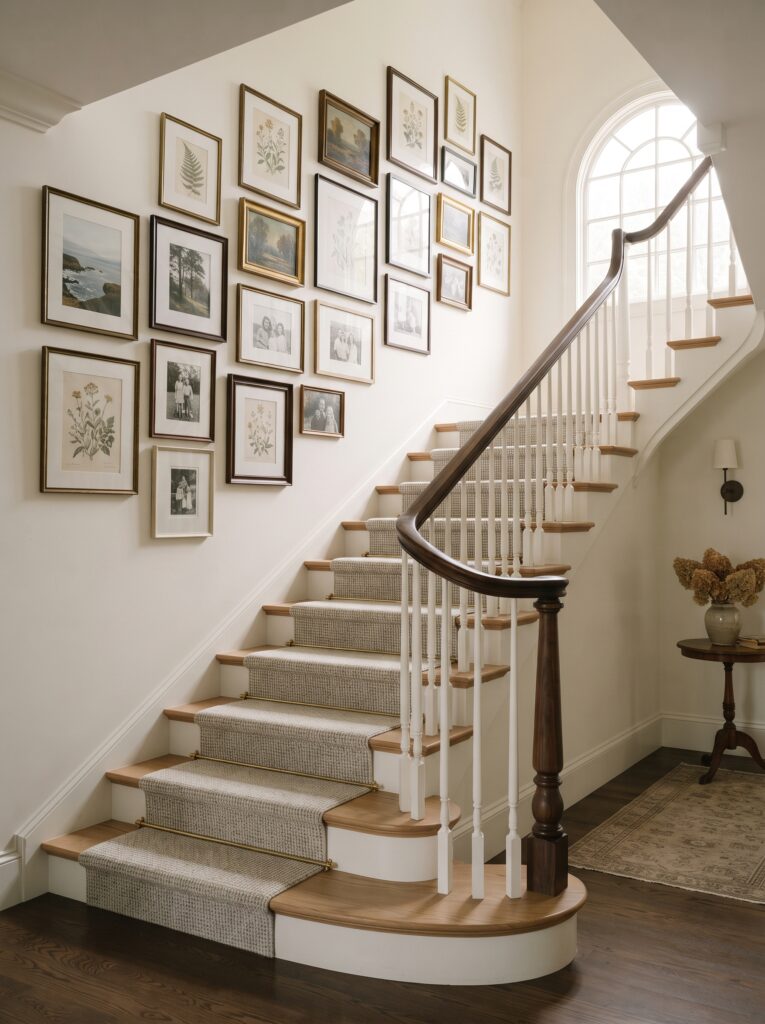
A thoughtfully designed staircase gallery wall can turn that forgotten space into one of the most memorable features of a home. It can make a plain hallway feel more personal, add character to a new-build house, and create a collected appearance without requiring a major renovation.
The challenge is finding the right balance. A staircase gallery wall should feel layered and interesting without becoming visually chaotic. The frames, artwork, spacing, colors, and placement all need to work together.
Whether your home is traditional, transitional, modern farmhouse, contemporary, or eclectic, there are many ways to create a staircase gallery wall that feels sophisticated and personal.
Why Decorate a Staircase Wall?
Staircase walls are naturally suited to gallery displays because they provide a long vertical area that can accommodate artwork at different heights.
Unlike a living room wall, the staircase does not necessarily need one large focal point. A collection can follow the movement of the stairs and create a visual journey from one floor to another.
This makes a staircase gallery particularly useful for displaying things that might not have an obvious home elsewhere.
You can combine:
- Family photographs
- Vintage artwork
- Botanical prints
- Landscape paintings
- Architectural sketches
- Children’s artwork
- Travel photographs
- Portraits
- Small mirrors
- Decorative objects
The key is not to display everything you own. A curated selection usually feels more sophisticated than a wall packed from edge to edge.
1. Follow the Angle of the Staircase
One of the most important rules for staircase gallery wall design is to work with the architecture.
Rather than arranging every frame in a straight horizontal line, allow the collection to rise gradually with the stairs.
The bottom pieces should begin near the lower portion of the staircase, while the arrangement gradually follows the upward angle.
This creates a natural visual flow.
Before hanging anything, place the artwork on the floor and experiment with the arrangement.
You can also cut paper templates the same size as the frames and attach them temporarily to the wall. This makes it easier to adjust the composition before making holes.
2. Start With One Large Anchor Piece
A gallery wall does not have to contain dozens of small frames.
One large piece can serve as an anchor, with smaller pieces arranged around it.
For example, a large landscape painting can sit near the center of the composition while smaller botanical prints, sketches, and photographs gradually extend along the staircase.
This creates hierarchy.
Without a dominant piece, a large gallery wall can sometimes feel visually flat.
The anchor artwork does not necessarily have to be colorful. A neutral vintage landscape or black-and-white photograph can be just as effective.
3. Mix Different Frame Styles
A collected home rarely looks as though every frame was purchased as a matching set.
Mixing frame styles can create a more authentic appearance.
Consider combining:
- Dark walnut frames
- Aged brass frames
- Antique gold frames
- Painted cream frames
- Natural oak frames
- Simple black frames
The trick is to create some repetition.
For example, if you use three different frame finishes, repeat each finish at least a couple of times throughout the composition.
This gives the gallery wall variety without making it look random.
4. Create a Mostly Neutral Gallery Wall
If you want a calm, elegant look, keep the artwork within a neutral palette.
Black-and-white photography, beige landscapes, botanical sketches, architectural drawings, and muted paintings can work beautifully together.
The frames can then provide subtle contrast.
A neutral staircase gallery is particularly effective in homes where the surrounding walls, flooring, and furniture already contain strong visual elements.
It adds interest without competing with the architecture.
5. Add Family Photography
A staircase can be an ideal place to display family photographs.
Instead of using a traditional grid, combine photographs with artwork.
For example, black-and-white family portraits can be mixed with botanical prints and small landscapes.
Using similar photo treatments can make the collection feel cohesive.
Black-and-white images are particularly versatile because they work with many different interior styles.
If you prefer color photography, consider selecting images with related tones rather than placing every bright photograph together.
6. Use Vintage Artwork for Character
Vintage artwork can make a new home feel more established.
Old landscape paintings, botanical illustrations, architectural drawings, and still-life artwork can introduce subtle history.
You do not need genuine antique pieces for every frame.
Vintage-inspired prints can create a similar visual direction while keeping the project more accessible.
Mixing newer family photographs with vintage-style artwork can also make the gallery feel personal rather than purely decorative.
7. Try a Black-and-White Photography Wall
For a more contemporary look, create a staircase gallery entirely from black-and-white photographs.
The photographs can feature family members, architecture, travel, landscapes, or everyday moments.
Use frames with a consistent finish for a cleaner appearance.
Black frames against a warm white wall create strong contrast.
For softer interiors, consider dark walnut frames instead.
This approach can work particularly well in modern, transitional, and minimalist homes.
8. Add Small Mirrors
Mirrors can add another dimension to a gallery wall.
A small vintage mirror can break up a collection of rectangular artwork and introduce a different shape.
Arched, oval, circular, or irregularly shaped mirrors can work depending on the style of the interior.
Mirrors are also useful because they reflect light.
However, use them selectively.
One or two mirrors within a larger gallery can feel intentional. Too many can make the arrangement feel visually fragmented.
9. Use a Consistent Color Story
The artwork does not have to match, but it should share some visual relationship.
Choose a color story before you begin.
For example:
Warm Neutral
Cream, beige, brown, muted green, and black.
Coastal
Soft blue, sandy beige, white, and natural wood.
Moody
Deep green, charcoal, burgundy, brown, and antique gold.
Traditional
Muted blue, cream, warm brown, olive, and brass.
Eclectic
Several colors, but repeated throughout the collection.
A color story helps unrelated artwork feel like part of one composition.
10. Create a Traditional Symmetrical Arrangement
If you prefer a more formal look, symmetry can work beautifully.
You might use matching frames and similar-sized artwork on either side of the staircase.
This creates a structured appearance.
Symmetry works particularly well in traditional American homes, formal hallways, and interiors with classic architectural details.
However, the arrangement should still follow the staircase rather than creating a rigid horizontal grid.
11. Try an Eclectic Collected Arrangement
For a more relaxed home, embrace variation.
Mix artwork sizes, frame finishes, orientations, and subjects.
The collection can feel as though it was gathered gradually over time.
This works particularly well with vintage furniture and traditional architecture.
The key is to create a few common elements.
Perhaps most artwork uses warm colors, or the majority of frames are wood.
These repeated details create visual cohesion.
12. Decorate a Narrow Staircase
A narrow staircase does not necessarily need a huge gallery wall.
In a compact area, choose smaller frames and maintain comfortable clearance around the staircase.
A vertical sequence of artwork can work better than a wide cluster.
You can also use narrow portrait-oriented pieces to emphasize the height of the wall.
Avoid allowing frames to extend into walking areas.
The gallery should enhance the staircase without creating a safety concern.
13. Use Oversized Artwork on a Wide Staircase
A wide staircase with a large blank wall provides more freedom.
Instead of filling the entire wall with small frames, consider several oversized pieces.
Large artwork can create a more luxurious and architectural appearance.
Three or four substantial pieces may have more impact than twenty small ones.
Use consistent spacing between the larger works to create structure.
14. Incorporate Architectural Prints
Architectural drawings can give a gallery wall an elegant, intellectual character.
Consider sketches of:
- Historic buildings
- European streets
- American architecture
- Bridges
- Gardens
- Floor plans
- Decorative details
These pieces work particularly well in traditional and European-inspired interiors.
They also provide visual interest without relying on bold colors.
15. Add Botanical Prints
Botanical artwork is one of the easiest ways to introduce a natural element.
Fern illustrations, flowers, leaves, branches, and vintage botanical studies can create a calm atmosphere.
For a sophisticated arrangement, mix botanical prints with landscapes and architectural sketches.
Keep the botanical colors relatively muted if you want a timeless appearance.
16. Create a Gallery Wall With Children’s Artwork
A staircase can also be an excellent place to display children’s art.
Instead of using random paper taped to the wall, give the artwork consistent frames.
This immediately creates a more polished presentation.
You can rotate the artwork throughout the year.
This approach allows the gallery wall to remain personal while also becoming part of the home’s design.
17. Use Picture Lights
Lighting can make artwork more noticeable after sunset.
Small picture lights installed above selected pieces can create an intimate gallery-like atmosphere.
You do not necessarily need a light above every frame.
One or two carefully positioned fixtures may be enough to highlight the main section.
If electrical work is involved, plan the wiring before installation and use qualified professionals where appropriate.
18. Coordinate the Gallery With the Stair Runner
The staircase itself is another opportunity to create visual continuity.
If the stairs have a runner, consider how its color relates to the artwork.
For example, a muted olive runner could connect with green botanical prints.
A warm beige runner could complement cream, brown, and gold artwork.
The elements do not need to match exactly.
Repeating subtle colors is enough.
19. Coordinate With the Flooring
Wood flooring can provide a natural connection with wooden frames.
Warm oak floors pair beautifully with walnut or natural wood frames.
If your floors are dark, lighter frames can create contrast.
If the flooring is light, darker frames can give the gallery wall definition.
Think of the wall and staircase as one visual composition.
20. Use One Frame Finish for a Cleaner Look
If mixing frames feels intimidating, choose one finish.
All-black frames create a contemporary appearance.
All-natural wood creates warmth.
Antique gold frames create a traditional feel.
Cream or white frames can create a softer cottage aesthetic.
A consistent frame finish allows you to mix different artwork without making the wall feel chaotic.
21. Leave Breathing Room
A common mistake is placing artwork too close together.
Gallery walls need breathing room.
Spacing depends on frame size, wall dimensions, and overall style, but the pieces should feel connected without touching.
Before installing the frames, step back and look at the entire arrangement.
If one section feels too dense, remove a piece rather than automatically adding another.
Empty space is part of the design.
22. Avoid Making Every Piece the Same Size
A gallery wall can become monotonous if every frame is identical.
Mixing sizes creates rhythm.
For example:
- One large horizontal landscape
- Two medium portrait pieces
- Three small sketches
- One small mirror
- One medium family photograph
This variation helps guide the eye along the staircase.
23. Make a Gallery Wall Feel Expensive
The most sophisticated gallery walls are usually carefully edited.
You do not need expensive artwork.
Focus on:
- Good-quality frames
- Consistent spacing
- Appropriate scale
- A cohesive color palette
- Interesting artwork
- Thoughtful lighting
- Clean installation
A $20 print can look beautiful in the right frame and composition.
Meanwhile, expensive artwork can look awkward if it is poorly arranged.
24. Choose Artwork That Has Meaning
A gallery wall becomes more interesting when at least some of the pieces have a story.
Maybe one photograph represents a favorite trip.
Maybe a painting came from a family member.
Maybe a botanical print reminds you of a garden you love.
These details make the home feel personal.
Decorating trends come and go, but meaningful objects tend to remain relevant.
25. Use a Staircase Gallery to Connect Two Floors
A staircase physically connects different areas of a house.
A gallery wall can reinforce that connection.
Choose artwork that relates to both floors rather than making the staircase feel disconnected from the rooms around it.
For example, if the first floor uses warm neutrals and the upstairs hallway uses muted blue, the staircase artwork could include both tones.
This creates a subtle transition.
26. Staircase Gallery Wall Ideas for Different Home Styles
Traditional
Use antique-style frames, landscapes, portraits, botanical artwork, and classic molding.
Transitional
Combine simple wood or black frames with modern photography and traditional artwork.
Modern Farmhouse
Use natural wood frames, black-and-white photography, botanical prints, and simple typography-free artwork.
Cottage
Choose floral prints, soft landscapes, vintage frames, and delicate colors.
Eclectic
Mix different frame finishes, artwork styles, mirrors, photographs, and collected objects.
Modern
Use fewer, larger pieces with consistent frames and plenty of negative space.
27. Mistakes to Avoid
One of the most common mistakes is ignoring the staircase angle.
Another is choosing frames that are too large for a narrow wall.
Poor spacing can also make a gallery wall look messy.
Using too many unrelated colors is another issue.
And finally, hanging artwork too high can make it difficult to appreciate as you walk past.
Take time to plan the placement before permanently installing anything.
How to Plan Your Staircase Gallery Wall
Start by measuring the available wall.
Take a photograph of the staircase from several angles.
Then collect the artwork you want to use.
Lay everything on the floor and experiment with different arrangements.
Start with the largest pieces and gradually add smaller artwork.
Once you have an arrangement you like, create paper templates.
Tape the templates to the wall and live with the arrangement for a day or two if possible.
Look at it from the bottom of the stairs, the top landing, and the hallway.
This simple planning process can prevent unnecessary holes and help you create a more balanced final result.
Conclusion
A staircase gallery wall can turn an overlooked part of your home into a meaningful design feature. It can introduce artwork, family memories, vintage character, color, and personality while making the transition between floors feel more intentional.
You do not need dozens of expensive frames or a professional designer to create the look.
Start with a clear visual direction. Choose artwork you genuinely enjoy, establish a color story, consider the staircase angle, and leave enough space for every piece to breathe.
For a timeless American home, a combination of warm wood or antique-inspired frames, neutral artwork, family photography, botanical prints, and subtle vintage details can create a collected appearance that feels personal rather than overly styled.
Most importantly, let the gallery wall tell a story. The staircase is a part of the home that people naturally pass every day, so transforming it into a display of meaningful images and artwork can make an ordinary transition space feel like an intentional part of the home’s personality.
- Covered Patio Ideas for an Outdoor Room That Feels Like Home
- Staircase Gallery Wall Ideas That Feel Collected, Not Cluttered
- Built-In Home Bar Ideas for an Elevated Entertaining Space
- Fireplace Makeover Ideas That Instantly Elevate a Living Space
- Window Seat Ideas That Make Any Room Feel More Charming