
A ceiling is often the most overlooked surface in a home. We spend so much time choosing the right paint color, furniture, flooring, rugs, and wall decor that the fifth wall—the ceiling—often gets nothing more than a coat of basic white paint. But when thoughtfully designed, a ceiling can completely change the character of a room.
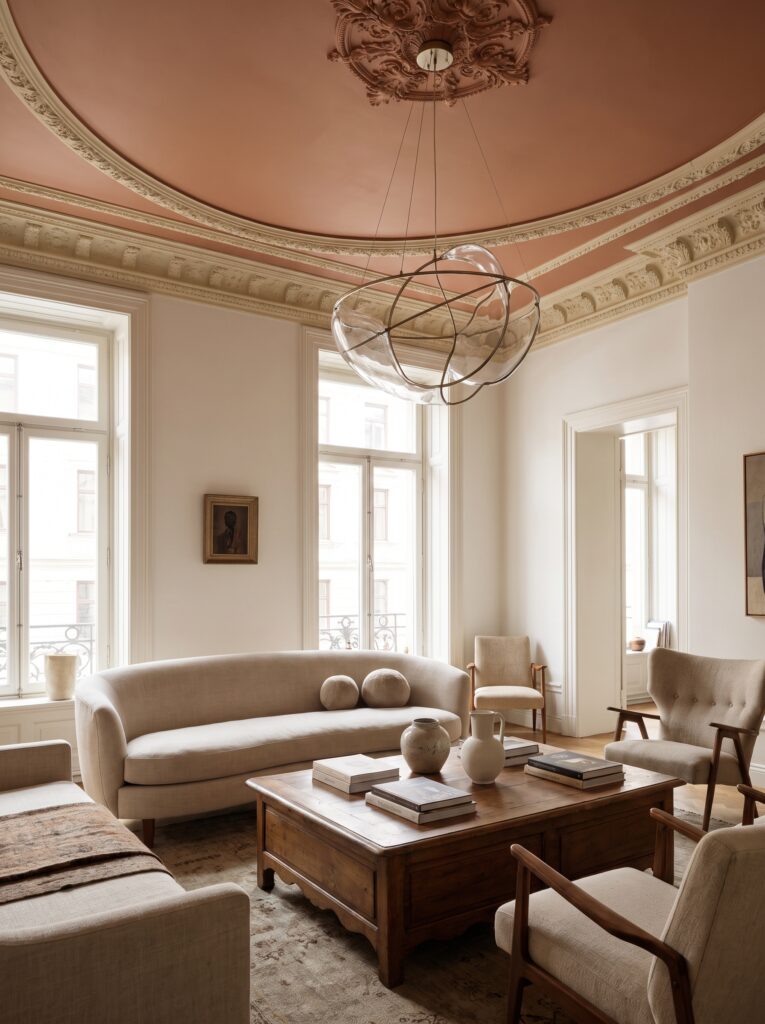
Statement ceiling ideas are becoming an exciting way to add personality, architectural interest, and a designer feel without replacing all the furniture in a space. From painted ceilings and decorative molding to wallpaper, exposed beams, wood details, and sculptural lighting, there are countless ways to make the ceiling part of the overall design.
The best part is that a statement ceiling doesn’t have to feel dramatic or overwhelming. A subtle color, delicate trim, or beautifully chosen light fixture can be enough to make a room feel more intentional.
If you’re looking for creative ceiling design ideas, ceiling decor ideas, or ways to make your home look more expensive, these ideas can help you rethink the space above you.
Why Statement Ceilings Are Worth Considering
Walls naturally attract attention because they are at eye level. Ceilings, however, can create a sense of surprise because they aren’t always the first place people expect to see decoration.
A thoughtfully designed ceiling can:
- Add architectural character
- Make a room feel more finished
- Create a visual focal point
- Introduce color without overwhelming the walls
- Emphasize interesting architectural features
- Make ordinary rooms feel more custom-designed
- Complement traditional, modern, vintage, or eclectic interiors
- Add personality to otherwise neutral spaces
This makes ceiling treatments particularly useful if you want a noticeable transformation without completely redesigning a room.
Instead of asking, “What should I put on this wall?” consider asking, “What could make the ceiling part of the design?”
That simple change in perspective can open up a surprising number of possibilities.
1. Paint the Ceiling a Beautiful Unexpected Color
Painting the ceiling is one of the easiest ways to experiment with a statement ceiling.
Instead of automatically choosing white, consider soft earthy tones, muted greens, warm beige, dusty blue, creamy yellow, or even a deeper shade for rooms where you want a moodier atmosphere.
For a sophisticated look, the ceiling doesn’t necessarily need to contrast dramatically with the walls. You can use different shades from the same color family.
For example, imagine soft warm beige walls paired with a slightly deeper caramel-toned ceiling. The difference is subtle, but it gives the room more depth.
For a more dramatic interior, you could use a deep navy, chocolate brown, charcoal, or burgundy-inspired shade overhead.
The key is to make the ceiling color feel connected to something else in the room. Pick up the same tone through a rug, artwork, upholstery, curtains, or decorative accessories.
This prevents the ceiling from looking like an isolated design decision.
2. Try a Tonal Ceiling for a Sophisticated Look
If you’re nervous about using a bold ceiling color, tonal decorating is a great alternative.
Choose one color family and use slightly different shades throughout the room.
For example:
Walls: warm cream
Ceiling: soft beige
Trim: creamy white
Furniture: natural wood and linen
Accessories: muted tan and brown
The result feels layered without being visually chaotic.
Tonal ceilings are especially beautiful in bedrooms, dining rooms, home offices, and sitting areas where you want a calm, sophisticated atmosphere.
This technique is also useful for homeowners who love neutral interiors but don’t want their rooms to look flat or generic.
3. Add Decorative Ceiling Molding
If you want your home to feel more architectural, decorative molding can make a major difference.
Ceiling molding can range from very simple trim to elaborate traditional patterns.
Some popular options include:
- Crown molding
- Picture-frame molding
- Coffered ceilings
- Tray-ceiling trim
- Geometric molding
- Decorative ceiling borders
- Beaded molding
- Simple linear trim
You don’t need an elaborate pattern to create an elegant result.
In fact, simple molding often looks more timeless than an overly complicated design.
A dining room with a beautifully framed ceiling, for example, can immediately feel more formal and finished. In a bedroom, subtle molding can create a refined backdrop without competing with the bed or artwork.
4. Make a Coffered Ceiling the Architectural Focal Point
Coffered ceilings are another excellent option for homeowners who want architectural interest.
A coffered ceiling typically uses recessed panels arranged in a geometric grid. It can look traditional, transitional, or modern depending on the materials and proportions.
For a classic American interior, white or warm neutral coffers can create a timeless appearance.
For a modern home, consider a simpler grid with clean lines and minimal decorative detailing.
You can also paint the recessed sections in a contrasting or complementary shade.
The goal is to make the architecture feel intentional rather than simply adding decoration for the sake of decoration.
5. Use Wood for Warmth and Texture
If your home feels too cold or visually plain, wood can bring warmth to the ceiling.
Wood ceiling treatments can include:
- Exposed beams
- Wood planks
- Slatted ceilings
- Reclaimed wood
- Natural wood panels
- Decorative wooden beams
- Light oak ceiling details
Natural wood works particularly well with neutral furniture, linen textiles, stone surfaces, leather accents, and greenery.
A warm wood ceiling can also make a large room feel more intimate because it introduces visual warmth overhead.
For a modern farmhouse-inspired home, lighter wood can create a relaxed atmosphere.
For a more sophisticated or vintage-inspired interior, darker wood can add depth and character.
6. Create Drama With Wallpaper
Wallpaper isn’t limited to walls.
Using wallpaper on the ceiling can create one of the most unexpected statement ceiling ideas, especially in smaller rooms.
A floral pattern can make a bedroom feel romantic. A subtle geometric print can work beautifully in a home office. A vintage-inspired pattern can bring character to a powder room or reading space.
If you’re worried about making the room feel too busy, keep the walls relatively simple.
This creates a beautiful balance where the ceiling becomes the feature while the rest of the room provides visual breathing space.
For a small powder room, for example, a patterned ceiling paired with simple walls and elegant lighting can create a surprisingly high-end effect.
7. Use a Sculptural Light Fixture
You don’t always need to redesign the entire ceiling.
Sometimes the lighting is enough.
A sculptural pendant or statement chandelier can function as both lighting and artwork.
Look for fixtures with interesting shapes, natural materials, unusual silhouettes, or beautiful craftsmanship.
Oversized lighting can work particularly well above:
- Dining tables
- Kitchen islands
- Entry spaces
- Bedrooms
- Sitting areas
- Home offices
The important thing is scale.
A tiny pendant can disappear in a large room, while an oversized fixture can become the focal point.
When choosing statement lighting, consider the height of the ceiling, the size of the room, and the furniture underneath it.
8. Experiment With a Striped Ceiling
For homeowners who want something more playful, stripes can create a memorable ceiling.
A striped ceiling can visually emphasize the length or width of a room depending on how the pattern is positioned.
Soft stripes in cream and beige can feel elegant and subtle.
Black and white stripes can create a stronger contemporary statement.
Muted colors can work beautifully in children’s rooms, creative spaces, or eclectic interiors.
The trick is to avoid adding too many competing patterns elsewhere.
If the ceiling has a strong stripe, let the furniture and walls remain relatively controlled.
9. Don’t Forget the Fifth Wall in a Small Room
A common misconception is that statement ceilings are only appropriate for large rooms.
In reality, smaller rooms can sometimes benefit even more from a carefully designed ceiling.
A compact powder room, hallway, closet, or home office can handle a stronger ceiling treatment because the space is limited and the ceiling becomes a natural opportunity for personality.
A small room with simple walls and a beautiful patterned ceiling can feel intentional rather than plain.
This is also a great way to experiment with a design idea before committing to it throughout your home.
10. Use the Ceiling to Highlight Architectural Character
Older American homes often have architectural features that shouldn’t be hidden.
Beams, ceiling medallions, unusual angles, exposed wood, recessed sections, and original molding can all become beautiful design elements.
Instead of trying to make an older home look completely new, consider emphasizing the details that give it personality.
For example, an original ceiling beam can be cleaned and restored rather than covered.
A vintage ceiling medallion can be paired with a modern chandelier.
Old architectural details can also look beautiful alongside contemporary furniture because the contrast makes both elements more noticeable.
11. Make the Ceiling Work With the Rest of the Room
A statement ceiling should feel like part of the room—not a completely separate idea.
Before choosing a ceiling treatment, look at:
The wall color:
Will the ceiling complement it or create too much contrast?
The flooring:
Does the ceiling repeat or balance the tones below?
The furniture:
Is the room already visually busy?
The lighting:
Will a ceiling treatment compete with the main fixture?
The architecture:
Are there beams, molding, or unusual angles worth emphasizing?
The natural light:
Will a dark ceiling make the room feel cozy or unnecessarily heavy?
Thinking about the entire room prevents the ceiling from becoming an afterthought.
12. How to Make a Statement Ceiling Look Expensive
You don’t necessarily need an expensive renovation to create a high-end ceiling.
The biggest difference often comes from proportion, consistency, and restraint.
Instead of adding several decorative elements at once, choose one strong idea.
For example:
- Beautiful molding + simple paint
- Wood ceiling + minimal lighting
- Wallpaper + understated furniture
- Statement chandelier + plain ceiling
- Bold ceiling color + neutral walls
Luxury interiors often feel expensive because every element appears intentional.
The goal isn’t to decorate every available surface.
It’s to create a visual hierarchy.
13. Best Statement Ceiling Ideas for Different Home Styles
Modern Homes
Try:
- Minimal geometric molding
- Wood slats
- Recessed lighting
- Sculptural pendants
- Simple monochromatic colors
Traditional Homes
Try:
- Coffered ceilings
- Crown molding
- Ceiling medallions
- Elegant chandeliers
- Soft neutral colors
Vintage-Inspired Homes
Try:
- Wallpaper
- Decorative molding
- Antique-style fixtures
- Restored ceiling details
- Warm paint colors
Modern Farmhouse Homes
Try:
- Exposed beams
- White or cream ceilings
- Natural wood
- Simple black lighting
- Subtle architectural trim
Eclectic Homes
Try:
- Patterned wallpaper
- Bold colors
- Unexpected lighting
- Decorative ceiling borders
- Mixed materials
14. Don’t Make Every Ceiling a Statement
This is an important design rule.
If every room in your home has an extremely dramatic ceiling, nothing feels special anymore.
Instead, choose one or two areas where you want to create an unexpected moment.
A dining room, powder room, bedroom, home office, or entryway can be an excellent place to experiment.
The rest of the house can remain relatively understated.
This creates contrast—and contrast is what makes a statement feature feel special.
15. Easy Ceiling Updates for Renters
Even renters can experiment with ceiling-inspired design without committing to permanent renovations.
Consider:
- Removable wallpaper where appropriate
- Plug-in pendant-style lighting
- Decorative lamps that draw the eye upward
- Temporary molding solutions
- Large-scale artwork positioned higher on walls
- Lightweight decorative elements
Always check your lease before making changes to ceilings, electrical fixtures, or permanent surfaces.
Even without structural changes, you can still create the visual effect of a thoughtfully designed ceiling by directing attention upward.
Conclusion
A beautiful home isn’t only about what happens at eye level. The ceiling has the potential to become one of the most interesting design features in a room, whether you choose a subtle tonal color, elegant molding, warm wood, patterned wallpaper, or a dramatic sculptural light fixture.
The best statement ceiling ideas aren’t necessarily the most complicated ones. Sometimes a simple change—such as painting the ceiling a warmer shade or adding a beautifully proportioned light fixture—is enough to make an ordinary room feel completely different.
If you’re planning your next home refresh, don’t automatically leave the ceiling white just because that’s what you’ve always done. Look up, consider the architecture, and think about how the fifth wall could contribute to the overall atmosphere of your home.
A thoughtfully designed ceiling can add character, warmth, depth, and that elusive designer-home feeling without requiring you to replace everything underneath it.
And sometimes, the smallest unexpected detail is exactly what makes a room unforgettable.
- Afrohemian Dining Room Ideas for a Warm, Collected and Sophisticated Home
- Warm Wood and Black Kitchen Ideas for a Timeless Designer Look
- Small Reading Nook Ideas That Turn Forgotten Corners Into a Cozy Luxury Retreat
- Curated Trinket Shelf Ideas: How to Create a Collected and Personal Home
- Neo Deco Entryway Ideas That Make Your Home Feel Instantly Expensive