
There is something special about a home that looks like it has been collected over time rather than decorated in one afternoon.
Maybe it’s a tiny ceramic piece discovered at a local antique shop, a postcard from a memorable trip, a vintage perfume bottle, a small framed photograph, an inherited keepsake, or a little object that simply makes you smile every time you see it. These small pieces may not seem important individually, but together they can tell the story of a home.
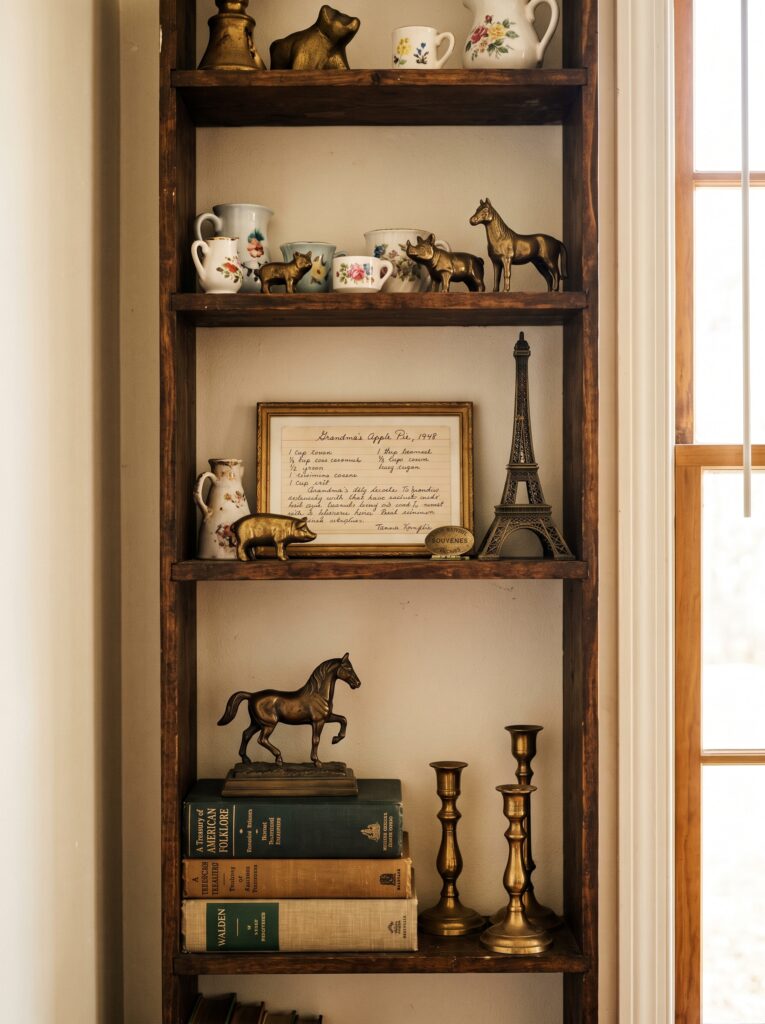
That is the idea behind the curated trinket shelf.
Instead of filling shelves with identical decorative objects purchased as a matching set, this approach focuses on personality, memories, vintage character, and intentional styling. The result is a space that feels warmer, more personal, and much less predictable.
And you don’t need an enormous built-in bookcase to try it. A narrow floating shelf, small wall ledge, cabinet, dresser, console, or even a dedicated display nook can become a beautiful place for your favorite little treasures.
What Is a Trinket Shelf?
A trinket shelf is essentially a small display area dedicated to objects that have visual or sentimental value.
Unlike traditional shelving, where the primary purpose might be storage, a trinket shelf is more about display and storytelling.
You might find:
- Tiny ceramic sculptures
- Vintage glass bottles
- Small framed artwork
- Travel souvenirs
- Jewelry boxes
- Candlestick holders
- Miniature paintings
- Old photographs
- Decorative boxes
- Small plants
- Collectible objects
- Handmade pottery
- Vintage books
- Brass pieces
- Family keepsakes
The beauty is that there isn’t one correct formula.
Your shelf should look like you.
That’s what separates a curated display from a generic decorating arrangement.
Why Personalized Shelves Feel So Much Better
Perfectly coordinated decor can certainly look beautiful, but sometimes it can also make a home feel slightly impersonal.
When every accessory comes from the same collection and everything matches perfectly, there is very little evidence of the people actually living there.
A curated trinket shelf does the opposite.
It introduces little imperfections and unexpected combinations.
A modern ceramic object might sit beside an antique brass frame. A travel souvenir might appear next to a vintage candleholder. A contemporary art print might be layered behind an old family photograph.
Those contrasts create character.
Your home starts to feel collected rather than decorated.
1. Start With the Objects You Already Own
Before buying anything new, walk around your home and look for small objects that you genuinely like.
Check:
- Old boxes
- Books
- Framed photographs
- Ceramics
- Travel souvenirs
- Small artwork
- Vintage finds
- Decorative dishes
- Candles
- Small sculptures
- Family keepsakes
You may be surprised by how many beautiful display pieces you already have.
This approach is also budget-friendly because you’re styling your home with things that already have meaning.
2. Choose a Shelf With the Right Proportions
The shelf itself matters.
A very deep shelf can become cluttered quickly, while an extremely narrow shelf may limit the types of objects you can display.
For small collections, a slim picture ledge or floating shelf can work beautifully.
For larger collections, consider:
- Built-in shelving
- Open cabinets
- Glass-front cabinets
- Vintage wall shelves
- Console shelving
- Bookcases
- Dresser tops
The goal is to choose a display surface that fits the scale of both your room and your collection.
3. Create Different Heights
One of the easiest ways to make a shelf look professionally styled is to avoid placing everything at the same height.
Imagine six objects all lined up at exactly the same level.
The display will probably feel flat.
Instead, create variation.
Place a taller vase or framed artwork toward the back. Add medium-height ceramics nearby. Then use small objects toward the front.
This creates a visual rhythm.
Your eye naturally moves from one object to another instead of seeing one straight horizontal line.
4. Layer Instead of Lining Everything Up
Another common mistake is placing every object side by side.
Instead, try layering.
A small frame can lean against the wall behind a ceramic object.
A book can sit underneath a tiny sculpture.
A shallow decorative bowl can overlap slightly with another object.
Layering creates depth and makes the display feel more relaxed.
It also helps smaller shelves feel visually richer without adding dozens of objects.
5. Leave Empty Space
This might be the most important rule.
Don’t fill every inch.
Empty space allows individual pieces to stand out.
If your shelf is crowded from one end to the other, beautiful objects can lose their impact.
Think of empty space as part of the composition.
A small gap between groups of objects can make the entire shelf feel more sophisticated.
Instead of asking, “What else can I add?”
Ask:
“What can I remove?”
Sometimes editing a display makes a bigger difference than buying another accessory.
6. Group Objects Into Small Vignettes
Rather than treating the entire shelf as one arrangement, divide it visually into small groups.
For example:
Vignette One
Vintage frame + small brass object + book
Vignette Two
Ceramic vase + tiny sculpture + dried stem
Vignette Three
Travel souvenir + photograph + decorative box
These small groupings create structure while still allowing the entire shelf to feel collected.
7. Mix Old and New
One of the easiest ways to create a sophisticated display is to combine different eras.
A completely vintage shelf can sometimes feel like an antique store.
A completely modern shelf can sometimes feel like a furniture showroom.
But mixing the two creates tension and personality.
Try combining:
Vintage + modern
Handmade + mass-produced
Rough + polished
Organic + geometric
Traditional + contemporary
For example, an antique brass candlestick can look surprisingly beautiful beside a modern sculptural ceramic.
That contrast is what makes the display interesting.
8. Use Books as Display Tools
Books aren’t only for reading.
They can also help create height and structure.
Stack two or three books horizontally and place a small object on top.
You can also stand books vertically behind shorter objects.
Choose books with covers or spines that complement the overall color palette.
If you don’t want the shelf to feel too colorful, neutral-toned books can provide a subtle foundation.
9. Add Something Living
A little greenery can prevent a collection from feeling too static.
You don’t need a large plant.
Consider:
- A tiny potted plant
- Small trailing vine
- Miniature succulent
- Fresh flower in a small vase
- Dried botanical stems
The organic shape of greenery contrasts beautifully with hard objects like ceramics, metal, glass, and wood.
Even one small plant can make a display feel more alive.
10. Let Travel Memories Become Decor
Souvenirs don’t have to remain hidden in drawers.
A curated shelf is a beautiful way to display meaningful travel memories.
Instead of purchasing generic souvenirs, look for small objects that have visual character:
- Handmade ceramics
- Small textiles
- Vintage postcards
- Local artwork
- Decorative tiles
- Tiny sculptures
- Traditional craft pieces
The important thing is to display them thoughtfully rather than turning the shelf into a crowded collection of souvenirs.
Choose your favorites.
You don’t have to display everything.
11. Create a Vintage Trinket Shelf
If you love vintage interiors, lean into the idea completely.
Look for small pieces at:
- Flea markets
- Estate sales
- Antique shops
- Thrift stores
- Vintage markets
- Local secondhand stores
You might find an old brass frame, decorative box, ceramic figurine, vintage glass bottle, or unusual candlestick for very little money.
The goal isn’t to find expensive antiques.
It’s to find pieces with character.
A few imperfect vintage objects can give a shelf much more personality than a collection of brand-new matching accessories.
12. Use Color to Connect Everything
Your objects don’t need to match, but having a loose color story can make the arrangement feel intentional.
For example, you might choose:
Warm neutrals: cream, tan, brown, brass
Earthy: olive, terracotta, beige, walnut
Moody: charcoal, burgundy, dark green, aged brass
Soft: dusty blue, cream, blush, pale wood
Classic: black, white, walnut, brass
This doesn’t mean every object must follow the palette perfectly.
One unexpected color can actually make the display more interesting.
13. Try a Monochromatic Trinket Display
If you prefer minimalist interiors, you can create a trinket shelf without introducing lots of colors.
Choose objects primarily in one color family.
An all-white shelf, for example, could combine:
- White ceramics
- Ivory books
- Pale stone objects
- Cream frames
- Light-colored candles
The interest comes from differences in shape and texture rather than color.
This is particularly effective in modern or Scandinavian-inspired interiors.
14. Make a Small Shelf the Feature
You don’t need an entire wall.
Sometimes one tiny shelf placed in an unexpected location creates more impact.
Consider a small display shelf:
- Beside a doorway
- Above a desk
- Near a staircase
- Inside a hallway
- Above a dresser
- Beside a window
- In a powder room
- Near a reading chair
These unexpected locations can turn otherwise forgotten areas into memorable details.
15. Style a Trinket Shelf in a Bedroom
A bedroom display should feel personal and calm.
Instead of filling the shelf with random decorations, use objects that contribute to the room’s atmosphere.
A small ceramic vase, framed photograph, favorite book, jewelry box, candle, and delicate artwork can create a beautiful arrangement.
Keep the colors relatively soft if you want the bedroom to remain restful.
16. Create a Story Shelf in a Home Office
Your home office can be a wonderful place to display objects related to your interests.
For example:
- Books about subjects you love
- Small artwork
- Travel memories
- Vintage stationery
- Decorative objects
- Inspirational pieces
- Handmade ceramics
This makes the workspace feel less corporate and more personal.
17. Don’t Buy Everything at Once
A truly collected home usually doesn’t happen overnight.
Allow your display to evolve.
You might find one beautiful object this month and another several months later.
Over time, the shelf becomes a visual record of your taste and experiences.
This is much more interesting than buying twenty accessories at once simply to fill an empty shelf.
18. The Secret to Making It Look Designer
Professional-looking shelves aren’t necessarily filled with expensive objects.
They are usually edited carefully.
A good arrangement often includes:
- One dominant object
- A few medium pieces
- Several small accents
- Different heights
- Different textures
- A little empty space
- One or two unexpected elements
Think about balance rather than symmetry.
You don’t need identical objects on both sides.
In fact, slight asymmetry often makes a display feel more natural.
19. Avoid These Common Trinket Shelf Mistakes
Too Many Small Objects
When everything is tiny, nothing becomes a focal point.
Include at least one larger or taller piece.
Everything Matches
Matching accessories can make the shelf feel generic.
Introduce different materials and eras.
No Empty Space
A crowded shelf quickly becomes visually overwhelming.
Edit ruthlessly.
Everything Faces Forward
Objects don’t always need to face directly toward the room.
Try leaning artwork, turning ceramics slightly, or grouping objects at different angles.
Buying Decor Just to Fill Space
The most beautiful shelves aren’t necessarily the fullest.
Display things because you love them—not because the shelf looks empty.
20. Make the Shelf Reflect Your Personality
This is ultimately what makes a trinket shelf worth creating.
Maybe you’re drawn to vintage objects.
Maybe you love ceramics.
Maybe you collect travel memories.
Maybe you enjoy art.
Maybe you’re fascinated by old books.
Maybe your favorite things are completely random.
That’s okay.
Your shelf doesn’t need to follow a specific interior-design aesthetic.
A home should have evidence of the people who live there.
The little objects around your home can communicate your personality in a way that perfectly coordinated furniture never can.
Conclusion
The beauty of a curated trinket shelf isn’t really about the shelf itself. It’s about creating a small visual collection of things that make your home feel personal.
Instead of decorating simply to follow a trend, use the trend as an invitation to rediscover what you already own and display it in a more thoughtful way.
Mix old and new pieces. Add meaningful souvenirs. Layer books with ceramics. Introduce a little greenery. Play with different heights and textures. Most importantly, leave enough breathing room for every special object to be appreciated.
A beautiful home doesn’t have to look perfectly styled at every moment. Sometimes the most memorable interiors are the ones that reveal a little history.
Your favorite little things deserve to be seen—not hidden away in a drawer.
- Afrohemian Dining Room Ideas for a Warm, Collected and Sophisticated Home
- Warm Wood and Black Kitchen Ideas for a Timeless Designer Look
- Small Reading Nook Ideas That Turn Forgotten Corners Into a Cozy Luxury Retreat
- Curated Trinket Shelf Ideas: How to Create a Collected and Personal Home
- Neo Deco Entryway Ideas That Make Your Home Feel Instantly Expensive