
A beautiful home doesn’t always need more furniture, more accessories, or a larger decorating budget. In many cases, adding more things can actually make a room feel less sophisticated.
One of the simplest interior design principles for creating an expensive-looking home is the one-hero-piece decorating rule.
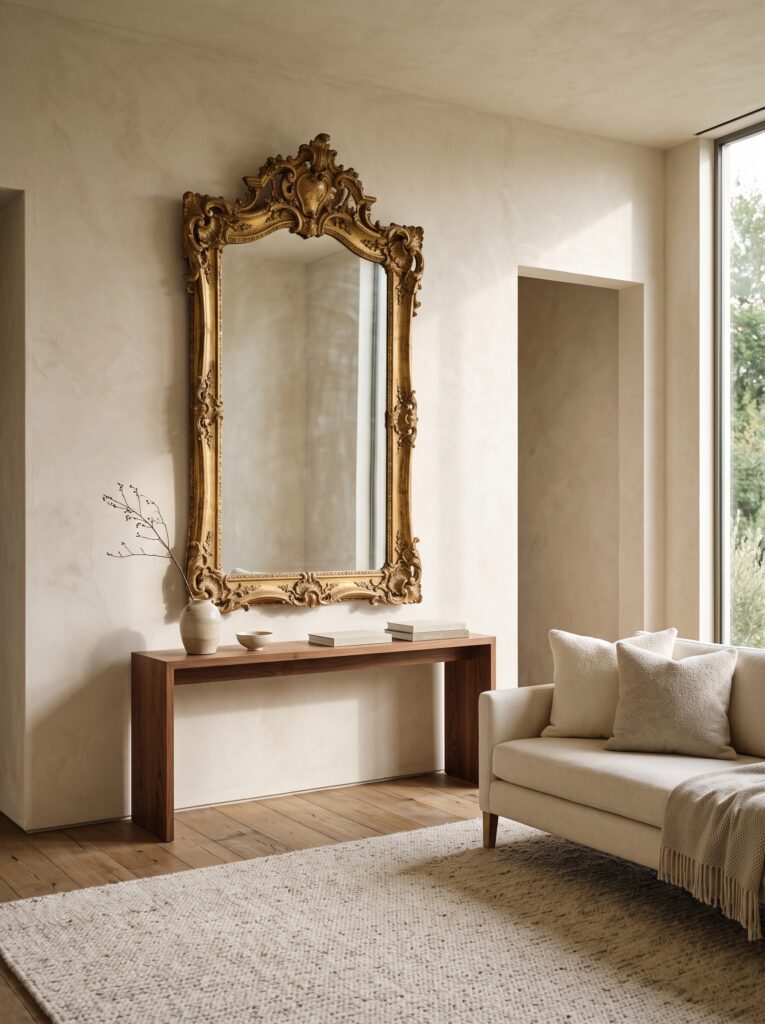
The idea is straightforward: instead of allowing dozens of decorative objects to compete for attention, choose one memorable statement piece and let the rest of the room support it.
That hero piece might be an oversized mirror, dramatic artwork, sculptural chair, vintage cabinet, statement pendant, unusual coffee table, architectural fireplace, or another distinctive feature.
The rest of the room can remain relatively calm.
This approach creates visual hierarchy, makes the room easier to appreciate, and gives the impression that every design decision was intentional.
For homeowners across the United States who want a more elevated interior without completely redecorating, the one-hero-piece rule is one of the easiest strategies to try.
What Is a Hero Piece in Interior Design?
A hero piece is the item that immediately captures attention when someone enters a room.
It becomes the visual anchor.
Instead of having five or ten competing focal points, the room has one dominant feature.
For example:
Neutral living room + oversized vintage mirror
Minimal dining room + sculptural chandelier
Simple bedroom + dramatic upholstered headboard
Quiet home office + large statement artwork
Simple entryway + antique console
The hero piece doesn’t necessarily have to be the most expensive object in the room.
It simply needs to have enough character, scale, shape, texture, or visual interest to stand out.
Why One Statement Piece Makes a Room Look More Expensive
Luxury interiors often feel expensive because they are visually controlled.
The eye knows where to look.
There is breathing room.
The furniture has enough space.
The accessories aren’t competing with one another.
A single hero piece creates this type of hierarchy.
Instead of seeing ten small decorative objects immediately, the eye notices one strong feature and then gradually discovers the supporting details.
This creates a more sophisticated experience.
The Difference Between a Statement Piece and Clutter
A statement piece is not the same thing as a room filled with dramatic objects.
Imagine a living room with:
- Oversized artwork
- Dramatic chandelier
- Sculptural coffee table
- Patterned rug
- Bright accent chair
- Bold curtains
- Large decorative mirror
- Multiple colorful accessories
Every individual piece might be beautiful.
Together, they can become visually exhausting.
Now imagine:
- Cream sofa
- Simple rug
- Walnut coffee table
- Neutral curtains
- Minimal accessories
- One enormous vintage artwork
The second room may feel significantly more luxurious.
Why?
Because the artwork has room to breathe.
1. Oversized Artwork as the Hero Piece
Large artwork can instantly transform an otherwise simple room.
Instead of creating a gallery wall with many small frames, consider using one large piece.
It could be:
- Abstract art
- Vintage landscape
- Black-and-white photography
- Oversized botanical artwork
- Traditional painting
- Contemporary canvas
- Textile art
The artwork becomes the visual anchor.
Keep the furniture around it relatively simple.
This approach works particularly well above:
- Sofas
- Consoles
- Beds
- Dining tables
- Fireplaces
2. An Oversized Mirror
A large mirror can serve as both decoration and function.
It reflects light and can visually expand the room.
Choose a mirror with a distinctive frame.
Possibilities include:
- Antique gold
- Aged brass
- Dark wood
- Carved wood
- Arched frame
- Organic shape
- Vintage finish
An oversized mirror can become especially dramatic in an entryway or dining room.
3. A Sculptural Chair
Sometimes the hero piece doesn’t need to be huge.
A beautifully shaped chair can become the focal point of a room.
Look for unusual silhouettes:
- Curved backs
- Sculptural arms
- Vintage shapes
- Textured upholstery
- Distinctive woodwork
Place the chair where it can be appreciated rather than hiding it in a corner.
Pair it with simpler furniture so its shape becomes noticeable.
4. A Statement Lighting Fixture
Lighting is one of the most effective ways to create a focal point.
A dramatic chandelier or pendant can completely change the atmosphere of a room.
Consider:
- Oversized pendant lights
- Sculptural chandeliers
- Vintage fixtures
- Handcrafted lighting
- Architectural sconces
- Organic-shaped pendants
A statement light is especially effective above:
- Dining tables
- Kitchen islands
- Entryways
- Staircases
- Bedroom seating areas
The rest of the room can remain understated.
5. A Vintage Cabinet
A beautiful vintage cabinet can bring instant character to a modern interior.
Look for:
- Interesting wood grain
- Antique hardware
- Carved details
- Unusual proportions
- Aged finish
Place it against a simple wall.
Add one or two carefully selected objects on top.
The cabinet becomes the story.
6. A Dramatic Headboard
In the bedroom, the bed naturally becomes the focal point.
Instead of relying on multiple accessories, make the headboard the hero.
Try:
- Oversized upholstered headboards
- Curved headboards
- Wall-to-wall fabric
- Vintage-inspired wood
- Architectural paneling
Keep the bedding relatively restrained.
This allows the headboard to dominate without making the room feel overwhelming.
7. A Sculptural Coffee Table
A coffee table doesn’t have to be visually boring.
Choose a table with an unusual silhouette.
Think:
- Organic shapes
- Stone
- Travertine
- Dark wood
- Sculptural bases
- Curved edges
When the rest of the furniture is simple, the coffee table becomes an artistic feature.
8. A Statement Fireplace
If your home has a fireplace, you already have a natural architectural focal point.
Instead of covering the mantel with dozens of accessories, keep the styling restrained.
A large artwork or mirror can be enough.
You can also emphasize the fireplace itself through:
- Natural stone
- Textured plaster
- Dark paint
- Architectural molding
- Beautiful tile
Sometimes the architecture should be the hero.
9. An Architectural Feature
Not every hero piece has to be furniture.
An architectural element can create the strongest focal point in the room.
Examples include:
- Arched doorway
- Exposed beams
- Decorative molding
- Statement staircase
- Stone wall
- Built-in shelving
- Paneled wall
When the architecture is strong, reduce the amount of decorative competition around it.
Choosing the Right Hero Piece
Before selecting a statement piece, consider the room.
Ask:
What do I want people to notice first?
Then choose accordingly.
If the room already has beautiful architectural details, you may not need another dramatic feature.
If the room is plain, artwork or furniture can provide the visual interest.
The hero piece should solve a design problem rather than create another one.
How Large Should the Hero Piece Be?
Scale matters.
A tiny artwork above a large sofa may look insignificant.
A small lamp on a massive console may disappear.
On the other hand, an oversized piece can sometimes make the room feel more sophisticated.
Don’t be afraid of scale.
Large artwork, mirrors, and lighting can create a designer appearance because they make a confident visual statement.
How to Make an Affordable Hero Piece Look Expensive
Price isn’t the only factor that determines whether something looks luxurious.
Presentation matters.
Choose pieces with:
- Interesting proportions
- Natural materials
- Good texture
- Strong silhouettes
- Timeless shapes
- Quality-looking finishes
Then surround them with simpler objects.
A vintage mirror from a thrift store can look incredible when placed against a beautifully painted wall with minimal furniture around it.
The surrounding space gives the piece importance.
The Importance of Negative Space
Negative space is the empty area surrounding your hero piece.
It is essential.
If your oversized artwork is surrounded by dozens of accessories, it loses impact.
If a sculptural chair is surrounded by clutter, it becomes less noticeable.
Allow the hero piece to breathe.
Think of negative space as part of the design.
Use Supporting Pieces, Not Competing Pieces
The rest of your furniture and accessories should support the hero piece.
For example, if your artwork is dramatic, choose simpler furniture.
If your chandelier is sculptural, avoid another oversized light fixture nearby.
If your coffee table is visually unusual, keep the surrounding accessories restrained.
Supporting pieces should complement the hero.
They shouldn’t compete with it.
One Hero Piece in a Neutral Interior
Neutral interiors are perfect for this decorating strategy.
Imagine:
- Warm white walls
- Cream sofa
- Natural oak
- Beige rug
- Linen curtains
- One oversized black-and-white photograph
The neutral surroundings make the artwork much more powerful.
The same concept works with a colorful piece.
A deep red artwork can become dramatic against a warm cream wall.
A dark green cabinet can become the focal point in a beige room.
One Hero Piece in a Colorful Room
You can still use this principle in colorful interiors.
The key is choosing one dominant statement.
For example:
Muted blue walls + sculptural red chair
or
Olive green room + oversized antique mirror
or
Warm terracotta walls + dramatic black pendant
The hero piece should create contrast without fighting every other element in the room.
Hero Pieces for Different Rooms
Living Room
Choose:
- Oversized artwork
- Sculptural coffee table
- Statement chair
- Large mirror
Bedroom
Choose:
- Dramatic headboard
- Statement pendant
- Oversized artwork
Dining Room
Choose:
- Sculptural chandelier
- Antique cabinet
- Statement artwork
Entryway
Choose:
- Oversized mirror
- Vintage console
- Dramatic artwork
Home Office
Choose:
- Statement desk
- Large artwork
- Sculptural chair
Kitchen
Choose:
- Statement lighting
- Unique island stools
- Architectural backsplash
The One-Hero-Piece Rule for Small Homes
This strategy is especially useful in small spaces.
When a room is small, adding lots of decorative pieces can make it feel crowded.
Instead, choose one strong feature.
For example:
A small apartment living room might need only:
Neutral sofa + simple coffee table + textured rug + one oversized artwork.
The room can feel more intentional because there is less visual noise.
Don’t Make Everything a Statement
This is one of the most important rules.
If everything is dramatic, nothing feels dramatic.
You don’t need:
- Statement artwork
- Statement lighting
- Statement furniture
- Statement rug
- Statement curtains
all at the same time.
Choose one.
Let the rest be quieter.
How to Create a Hero Piece With What You Already Own
Before buying something new, shop your own home.
Walk through every room.
Look for something that has:
- Unusual shape
- Interesting texture
- Strong color
- Vintage character
- Personal meaning
- Large scale
A forgotten mirror might become the perfect entryway feature.
An old painting might become a dramatic focal point.
A vintage chair might become the star of your bedroom.
Sometimes you already own your best statement piece.
It simply needs a better location.
How to Find Affordable Statement Pieces
If you want to purchase something, look beyond traditional home decor stores.
Explore:
- Thrift stores
- Estate sales
- Antique markets
- Vintage shops
- Secondhand furniture stores
- Local artists
- Artisan markets
Look for pieces with personality.
A mass-produced decorative object may be technically beautiful, but a unique vintage find often creates more visual interest.
How to Style Around a Statement Piece
Once you’ve selected the hero, step back.
Ask:
What does this piece need?
Maybe it needs empty wall space.
Maybe it needs simple furniture.
Maybe it needs warm lighting.
Maybe it needs contrast.
Maybe it needs repetition of one color.
Avoid immediately adding more decor.
Give the hero piece time to define the room.
Common Mistakes
Too Many Focal Points
Choose one dominant visual feature.
Statement Pieces That Are Too Small
Scale matters.
Overdecorating Around the Hero
Leave breathing room.
Ignoring the Room’s Architecture
Work with existing features.
Choosing a Trend Instead of Something You Love
A hero piece should have staying power.
Using Too Many Colors
Keep supporting colors controlled.
The Psychology Behind a Strong Focal Point
Human eyes naturally look for visual hierarchy.
When a room has one clear focal point, the space becomes easier to understand.
You notice the statement piece first.
Then the furniture.
Then the smaller details.
This creates a sense of order.
That sense of order is one reason professionally designed rooms often feel so polished.
How This Rule Creates a Luxury Feeling
Luxury interiors aren’t necessarily defined by expensive objects.
They are often defined by restraint.
There is confidence in leaving space empty.
There is confidence in choosing one beautiful object instead of ten average ones.
There is confidence in allowing architecture, furniture, artwork, or lighting to speak for itself.
The one-hero-piece rule embraces exactly that philosophy.
A Simple Formula to Try Today
If you want to experiment with this approach, follow these steps.
Step 1: Choose One Hero
Pick the object you want people to notice first.
Step 2: Remove Competing Decor
Temporarily remove nearby accessories.
Step 3: Simplify the Furniture
Keep only what the room needs.
Step 4: Create Breathing Room
Give the hero piece visual space.
Step 5: Add Supporting Details
Introduce only a few complementary pieces.
Step 6: Check the Room From the Entrance
Look at the space from the doorway.
What do you notice first?
If your eye immediately lands on the hero piece, you’ve succeeded.
Conclusion
The one-hero-piece decorating rule proves that a luxurious-looking home doesn’t need to be filled with expensive furniture or countless decorative accessories. Choosing one memorable focal point and allowing the rest of the room to support it creates visual hierarchy, breathing room, and a much more intentional atmosphere. Whether your hero piece is oversized artwork, a vintage mirror, sculptural furniture, dramatic lighting, an antique cabinet, or a distinctive architectural feature, giving it enough space to shine can instantly elevate the entire room. The real secret is restraint: when everything is competing for attention, nothing feels special. But when one beautiful piece becomes the star, even a simple room can feel sophisticated, curated, and effortlessly designer-inspired.
- Moody Blue Room Ideas for a Sophisticated Cozy Home
- White Oak and Black Kitchen Ideas for a Modern Timeless Home
- The Garden Patio Ideas That Make Outdoor Spaces Feel Magical
- Dark Cottagecore Kitchen Ideas With Timeless Charm
- Warm Wood Kitchen Ideas That Make a Home Feel Instantly Expensive