
A beautiful home is not necessarily a home without things. Real families have shoes by the door, keys that seem to disappear at the worst possible moment, dog leashes, sunglasses, mail, gloves, chargers, and all those small everyday items that somehow end up scattered across the nearest surface.
The challenge is not eliminating these things. It is creating a place for them.
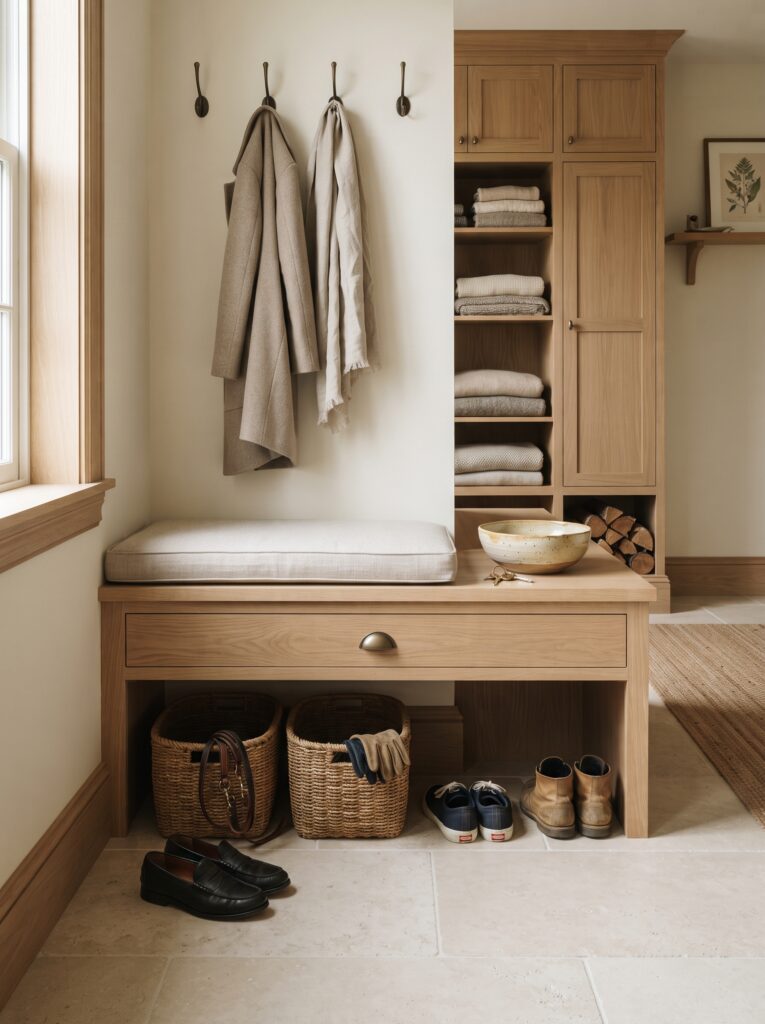
That is where smart mudroom storage ideas can make such a noticeable difference.
One of the most useful—and often overlooked—solutions is a shallow hidden drawer built directly into a mudroom bench. From the outside, the space can look clean and beautifully designed. Behind the drawer front, however, there is a practical little storage zone for the everyday items that tend to create visual clutter.
This approach combines organization with interior design instead of treating storage as something that has to be added afterward. Current home organization coverage is also putting more attention on overlooked spaces and concealed storage, including built-ins and furniture that can hide everyday belongings while maintaining a cleaner visual appearance.
If you are planning a mudroom makeover or simply want your existing entry area to work harder, a hidden drawer can be a surprisingly effective upgrade.
Why Mudroom Storage Matters So Much
The mudroom is one of the hardest-working spaces in an American home.
It often sits between the garage, driveway, backyard, or main entrance and the rest of the house. Because of that location, it naturally collects the objects people use when they are coming and going.
Think about what happens during an ordinary weekday morning.
Someone needs their keys. A child needs a jacket. Someone is looking for sunglasses. Shoes are removed. A dog leash comes off the hook. A package arrives. A reusable shopping bag needs to be grabbed before leaving.
Without a designated place for these items, they quickly spread across benches, countertops, console tables, kitchen islands, and other nearby surfaces.
A well-designed mudroom prevents that chain reaction.
Instead of trying to make people remember to put everything away perfectly, the room should make organization easy.
That is one reason concealed storage is so valuable. When the storage location is convenient, people are more likely to use it.
The Hidden Drawer Beneath a Mudroom Bench
A mudroom bench is already a practical feature because it provides a comfortable place to sit while putting on or removing shoes.
But the space beneath that bench can do much more than hold baskets.
A shallow drawer can be installed underneath the seating area and used as a daily drop zone.
Unlike a deep cabinet, a shallow drawer allows you to see and reach smaller belongings quickly.
You could use it for:
- House keys
- Sunglasses
- Dog leashes
- Gloves
- Wallets
- Reusable shopping bags
- Small umbrellas
- Chargers
- Headphones
- Sunscreen
- Hats
- Car-related items
- Children’s small accessories
The exact contents will depend on your household, but the principle remains the same: keep frequently used small items close to the door without leaving them visible.
Why a Shallow Drawer Can Be Better Than a Basket
Baskets are beautiful and useful, but they are not always ideal for small everyday objects.
Imagine placing keys, sunglasses, dog treats, and charging cables into one deep basket.
Everything is technically organized—but finding one particular item can still require digging.
A shallow drawer provides a different experience.
Items can be arranged in a single layer, making them easier to see and retrieve.
You can even add small dividers to create separate sections.
For example:
Section 1: keys and wallets
Section 2: sunglasses
Section 3: dog accessories
Section 4: miscellaneous daily essentials
The result is storage that feels almost invisible while remaining extremely practical.
Make the Drawer Look Like Part of the Architecture
The best concealed storage does not look like an obvious storage solution.
Instead, the drawer should feel integrated into the architecture of the mudroom.
This can be achieved by matching the drawer front to the surrounding cabinetry or bench.
Natural oak is particularly beautiful for this type of design because it adds warmth without making the room feel visually heavy.
For a more traditional American home, painted cabinetry can work beautifully.
For a transitional interior, consider:
- Warm oak
- Soft cream cabinetry
- Mushroom taupe
- Muted sage
- Warm gray
- Deep walnut
Hardware matters, too.
A small aged-brass pull can introduce a subtle decorative detail without making the drawer look overly ornate.
For a cleaner appearance, you could also use a recessed pull or push-to-open mechanism.
The goal is not to announce, “Look at this storage drawer.”
The goal is for someone to notice a beautifully designed bench first and discover the clever storage second.
Add a Comfortable Bench Cushion
The bench itself should remain comfortable enough for everyday use.
A tailored cushion can soften the appearance of built-in cabinetry and make the mudroom feel more like a designed room rather than a utility zone.
Neutral fabrics are particularly versatile.
Try:
- Oatmeal linen
- Warm ivory performance fabric
- Soft beige
- Muted olive
- Natural woven texture
If your household experiences a lot of outdoor traffic, choose a durable, easy-to-clean material rather than a delicate fabric that requires constant maintenance.
This is one area where beauty and practicality should work together.
A mudroom needs to survive real life.
Use the Wall Above the Bench Wisely
Once the lower section is organized, the wall above the bench becomes another opportunity to combine function and style.
Instead of filling the wall with decorative objects, consider a carefully planned combination of hooks, shelves, or cabinetry.
For example, you could install:
- Individual hooks for frequently used coats
- A narrow upper shelf
- Small baskets
- A framed piece of artwork
- A wall-mounted mirror
- A small architectural light
- A designated spot for bags
The trick is to avoid creating too many visual categories.
A mudroom already has plenty of activity happening at floor level. Keeping the wall treatment relatively restrained can make the entire space feel calmer.
Add Baskets—but Give Them a Specific Job
Woven baskets are still incredibly useful in mudrooms.
However, instead of having baskets that become general-purpose dumping zones, assign each one a specific function.
One basket might hold seasonal accessories.
Another could be used for hats and gloves.
A third could be reserved for outdoor items.
If you have children, individual baskets can also make organization easier because everyone has their own designated space.
This creates a simple system:
Hooks = things that are currently being used.
Drawers = small everyday essentials.
Baskets = larger soft accessories.
Closed cabinets = items you do not need every day.
That division makes the mudroom easier to maintain.
Don’t Forget the Shoes
Shoes are usually one of the biggest visual challenges in a mudroom.
Open shoe storage can work, but too many visible pairs can quickly make a beautiful room look chaotic.
If possible, incorporate closed shoe cabinets or drawers into the lower cabinetry.
Another option is to keep one easily accessible open shelf for the shoes currently in rotation and use concealed storage for everything else.
This creates a balance between convenience and visual calm.
The goal is not to hide every single object.
The goal is to make sure the room has a clear visual hierarchy.
A Mudroom Should Reflect the Rest of Your Home
One mistake people sometimes make is treating the mudroom as a completely separate design project.
Because it is a practical space, it can end up looking disconnected from the rest of the home.
Instead, carry a few materials and colors from nearby rooms into the mudroom.
If your home has warm oak flooring, repeat that wood tone.
If your kitchen uses aged brass hardware, consider using similar hardware here.
If your main living spaces feature warm ivory and taupe, bring those colors into the bench cushion or wall paint.
This creates continuity.
The mudroom may be functional, but it should still feel like part of the home.
How to Make a Small Mudroom Feel More Spacious
Not every American home has a large dedicated mudroom.
Some have a narrow hallway.
Others have a small space near the garage.
Some have only a few feet beside the back door.
That does not mean you have to sacrifice organization.
In a small mudroom, prioritize vertical storage.
Use the wall height.
A tall cabinet can provide significantly more storage than a low piece of furniture while keeping the floor relatively open.
A built-in bench with drawers underneath can also provide two functions in one footprint.
Current design advice increasingly emphasizes multifunctional furniture and subtle built-ins as ways to improve storage without making a room feel visually crowded.
Choose Materials That Can Handle Everyday Life
A mudroom needs materials that are beautiful but durable.
Natural wood is attractive, but it should be properly finished.
For countertops or bench surfaces, durable materials are preferable to delicate finishes.
For rugs, choose something washable or highly resistant to everyday dirt.
For upholstery, performance fabrics can be a practical choice for families with children or pets.
The best mudroom is not the one that looks perfect for a photograph.
It is the one that still looks good after being used every day.
Seasonal Organization Makes the Hidden Drawer Even More Useful
One advantage of concealed storage is that its contents can change with the seasons.
During winter, the drawer might hold:
- Gloves
- Hand warmers
- Hats
- Scarves
- Small winter accessories
In spring, you can switch it to:
- Sunglasses
- Lightweight accessories
- Sunscreen
- Dog-walking essentials
During summer:
- Outdoor accessories
- Small gardening items
- Extra sunglasses
- Reusable bags
This keeps the drawer relevant throughout the year instead of allowing it to become another forgotten storage compartment.
The Luxury Is Actually in the Convenience
When people talk about making a home feel expensive, they often focus on visible materials: marble, brass, designer furniture, expensive lighting.
But thoughtful organization can create an equally elevated feeling.
Imagine walking into your home and immediately knowing:
Where your keys are.
Where your shoes belong.
Where your bag goes.
Where the dog’s leash is.
Where your sunglasses are.
Where seasonal accessories are stored.
That level of ease is a form of luxury.
A well-designed home reduces small daily frustrations.
And that is exactly what makes a hidden mudroom drawer such a worthwhile idea.
How to Plan Your Own Hidden Mudroom Drawer
Before adding one, think about what your household actually needs.
Start by making a list of the small objects that usually accumulate around your entrance.
Do not design the drawer around an imaginary lifestyle.
Design it around your real one.
If your family carries several sets of keys, prioritize key organization.
If you walk a dog several times a day, create a dedicated section for leashes and waste bags.
If children use the space, consider easy-access compartments at a height they can reach.
The most successful organization systems are the ones people can use without thinking about them.
Final Design Details That Make the Space Feel Finished
Once the functional elements are in place, add only a few decorative details.
A handmade ceramic bowl can sit on the bench.
A simple mirror can reflect light.
A small framed artwork can bring personality.
A woven basket can add texture.
A single plant or branch can soften the cabinetry.
Avoid filling every surface.
Negative space is part of the design.
When the storage is doing most of the visual work, decoration becomes more powerful because there is less competition.
Conclusion
A hidden mudroom drawer may seem like a small design detail, but it can have a surprisingly large impact on how an entire home feels.
By giving keys, sunglasses, leashes, chargers, gloves, and other small essentials a dedicated hidden location, you can reduce everyday visual clutter without sacrificing convenience. Pair the drawer with a comfortable built-in bench, natural wood, thoughtful hooks, woven baskets, and durable materials, and the mudroom becomes more than a pass-through space—it becomes a carefully designed part of the home.
The most successful mudroom designs are not necessarily the biggest or most expensive. They are the ones that understand how people actually live.
And sometimes, the smartest luxury is simply having a place for everything—and being able to find it when you need it.
- The Tiny Balcony Idea That Turns Empty Space Into a Retreat
- The Vintage Cabinet Trick That Makes a Bathroom Feel Custom
- The Unexpected Living Room Feature That Creates Instant Architecture
- The Guest Bedroom Detail That Feels Like a Boutique Hotel
- The Hidden Mudroom Drawer That Makes Everyday Clutter Disappear