
A staircase is often one of the most overlooked decorating opportunities in a home. While homeowners spend plenty of time choosing furniture, lighting, rugs, and wall decor for their main living spaces, the staircase is frequently left with plain walls and very little personality. However, a well-designed staircase gallery wall can completely transform this transitional area and make the entire home feel more thoughtful, collected, and visually interesting.
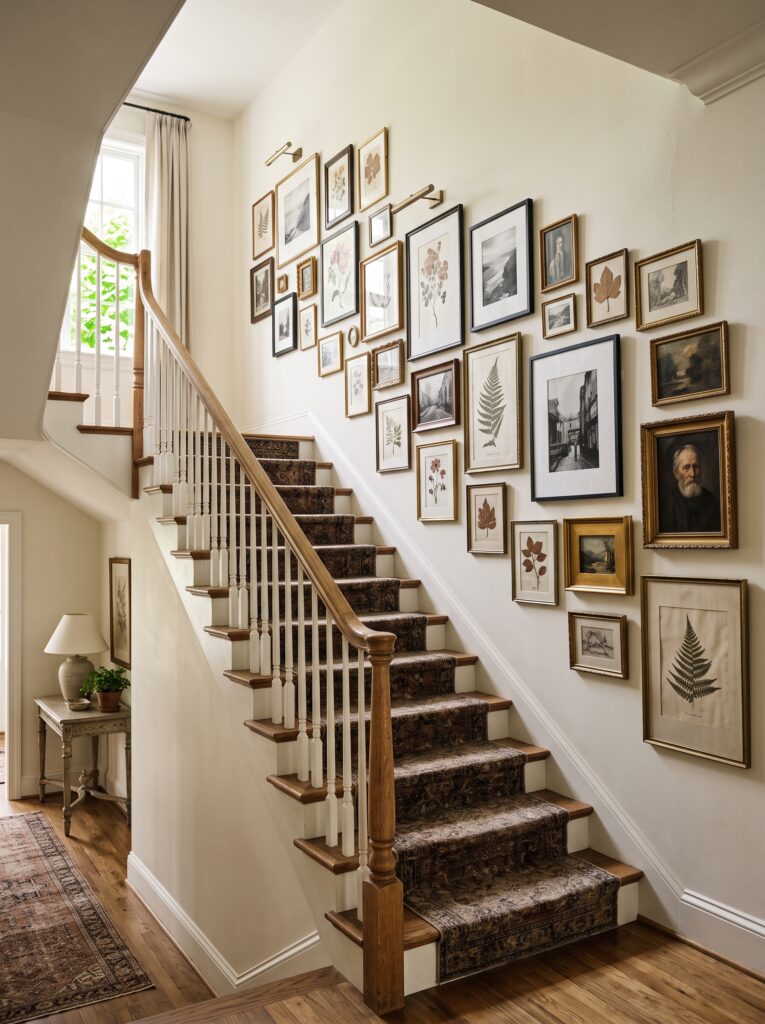
Whether you live in a traditional American house, a modern farmhouse, a contemporary home, or a small apartment with an open staircase, a gallery wall can turn an ordinary stairway into a standout architectural feature. The best part is that you do not need expensive artwork or a professional interior designer to achieve the look. With the right combination of frames, photographs, artwork, colors, and spacing, you can create a staircase gallery wall that looks intentional rather than cluttered.
Why Staircase Gallery Walls Are So Popular
Gallery walls have become a favorite interior decorating technique because they allow homeowners to display personality without sacrificing valuable floor space. A staircase is especially suitable for this type of decorating because the wall naturally follows an upward direction.
Instead of seeing a blank wall every time you walk upstairs, you can create a visual story that moves naturally from one level to another.
For many American homes, this is particularly useful because staircases are often located in entryways, hallways, foyers, or open-concept areas. A beautiful staircase gallery wall can therefore become one of the first design details guests notice when entering the home.
Another advantage is flexibility. Your gallery wall does not have to consist entirely of expensive artwork. You can combine family photographs, vintage prints, botanical illustrations, sketches, typography, children’s artwork, travel memories, and decorative objects.
The goal is to create a collection that feels personal and connected to the rest of your home.
Choose a Cohesive Color Palette
One of the easiest ways to make a staircase gallery wall look professionally designed is to establish a color palette before hanging anything.
This does not mean every frame or artwork needs to match perfectly. In fact, some variation can make the display feel more authentic.
Instead, choose two or three colors that appear throughout the collection.
For example, a warm neutral staircase might use:
- Cream
- Beige
- Warm brown
- Black
- Muted green
- Antique brass
A more traditional home could use:
- Navy
- Burgundy
- Cream
- Dark wood
- Antique gold
For a modern interior, consider:
- Black
- White
- Gray
- Natural wood
- Soft beige
Keeping the artwork connected through color helps different styles and frame sizes feel like one intentional collection.
Mix Different Frame Styles
One of the biggest mistakes homeowners make with gallery walls is believing every frame must be identical.
Matching frames can certainly create a clean and symmetrical appearance, but a staircase often looks more interesting when several frame styles are combined.
Try mixing:
- Thin black frames
- Natural oak frames
- Antique brass frames
- Dark walnut frames
- Vintage gold frames
- Simple white frames
The key is to repeat certain materials throughout the arrangement.
For example, if you use a brass frame near the bottom of the staircase, introduce another brass element farther up. The repetition creates visual balance.
You can also mix frame widths. A thin frame next to a heavier wooden frame can create depth and prevent the display from looking too uniform.
Create a Collected Look With Vintage Artwork
If you want your staircase to feel sophisticated and timeless, vintage-inspired artwork is an excellent choice.
Botanical illustrations, architectural sketches, landscape paintings, old maps, still-life artwork, and black-and-white photography can create a beautiful collected appearance.
You do not need every piece to come from the same collection.
In fact, combining different artwork styles can make the wall feel as though it was assembled gradually over many years.
This is especially effective in traditional, transitional, cottage, farmhouse, and old-house interiors.
The important thing is to keep the overall visual balance consistent.
Add Family Photos Without Making the Wall Feel Too Personal
Family photographs can make a staircase gallery wall feel warm and meaningful, but using too many photographs can sometimes make the display look more like a photo collage than an interior design feature.
A better approach is to mix personal photographs with decorative artwork.
For example, you could use:
- Two family portraits
- One black-and-white photograph
- Two botanical prints
- One landscape
- One abstract artwork
- One vintage-inspired illustration
This creates a balance between personal memories and decorative design.
Black-and-white photography is particularly useful because it works with almost any color palette.
Follow the Staircase Instead of Fighting It
A staircase gallery wall should visually follow the movement of the stairs.
Instead of creating a straight horizontal row, arrange your artwork so that the collection gradually rises with the staircase.
The lower pieces should generally begin lower on the wall, while the artwork continues upward as the stairs rise.
This creates a natural visual rhythm.
Before putting nails into the wall, place your frames on the floor and experiment with different arrangements.
You can also use paper templates taped to the wall to test the layout.
This simple step can prevent unnecessary holes and help you understand how the entire arrangement will look from different viewpoints.
Think About Viewing Height
Staircase walls are different from ordinary living room gallery walls because people view them while moving.
You may see the artwork from the bottom of the stairs, from the middle landing, or from upstairs.
Because of this, avoid placing every piece at exactly the same height.
Instead, focus on maintaining a balanced relationship between the artwork and the staircase.
Large pieces can act as anchors, while smaller frames can fill visual gaps.
The goal is not perfect mathematical symmetry. The goal is visual balance.
Use Large Artwork to Create a Focal Point
If your staircase wall is large, using only small frames can make the display feel scattered.
Include at least one or two larger pieces to establish a focal point.
A large landscape painting, oversized botanical print, vintage portrait, or dramatic abstract artwork can anchor the collection.
Then surround it with smaller pieces.
This creates a hierarchy where the eye naturally moves from the largest artwork to the smaller details.
It is one of the easiest ways to make a gallery wall look more intentional.
Consider the Staircase Landing
If your staircase includes a landing, do not treat it as a separate decorating problem.
Instead, connect the landing with the gallery wall.
You could continue the artwork around the corner or create a slightly larger focal arrangement at the landing.
A small bench, antique mirror, decorative plant, or console can also complement the artwork.
However, avoid overcrowding the landing.
Because staircases are high-traffic areas, maintaining enough walking space is essential.
Add an Antique Mirror
An unexpected way to make a staircase gallery wall more interesting is to incorporate a small mirror.
Instead of using artwork in every frame position, introduce one decorative mirror with an interesting shape.
A vintage oval mirror, arched mirror, or antique-style rectangular mirror can break up the artwork while reflecting natural light.
This is especially useful in darker staircases where additional visual brightness is needed.
A mirror also creates a layered appearance that can make the wall feel more sophisticated.
Try a Black-and-White Gallery Wall
For homeowners who prefer minimalist or modern interiors, a black-and-white staircase gallery wall can be incredibly elegant.
Use black frames with:
- Black-and-white photography
- Architectural prints
- Minimal sketches
- Abstract line drawings
- Typography
- Vintage newspaper-style artwork
The monochromatic palette keeps the wall cohesive even when the artwork varies.
Pair the display with warm wood flooring, neutral walls, and simple lighting to prevent the space from feeling too stark.
Create a Modern Organic Gallery Wall
If your home has an organic modern aesthetic, avoid overly formal frames.
Instead, combine natural oak frames, linen-mounted artwork, handmade ceramics, neutral photography, and earthy botanical prints.
Colors such as:
- Sand
- Olive
- Taupe
- Warm white
- Terracotta
- Soft brown
work beautifully in this style.
The result is relaxed but sophisticated and works particularly well with natural wood staircases and neutral interiors.
Make a Traditional Staircase Feel More Modern
A staircase in an older American home can sometimes feel visually heavy because of dark wood, traditional railings, or ornate architectural details.
A carefully edited gallery wall can modernize the space without removing its character.
Try combining traditional elements with contemporary artwork.
For example, pair antique brass frames with modern abstract prints or place vintage landscapes beside simple black-and-white photography.
This contrast creates an updated transitional look.
Don’t Forget Lighting
Even the most beautiful gallery wall can disappear in a dark staircase.
Lighting can dramatically improve the appearance of artwork.
Depending on the architecture of your home, consider:
- Picture lights
- Wall sconces
- Recessed lighting
- Adjustable ceiling lights
- Small directional spotlights
Warm lighting is particularly effective for traditional and vintage-inspired artwork because it enhances wood, brass, and warm frame finishes.
If you have artwork with strong colors, make sure your lighting does not create harsh glare.
Use the Gallery Wall to Tell a Story
The most memorable staircase gallery walls often have a story behind them.
Instead of randomly selecting attractive prints, think about what you want the collection to communicate.
For example, a family-oriented collection could include photographs from different generations.
A travel-inspired collection could include maps, landscapes, postcards, and architectural photography.
A nature-inspired collection could feature botanical prints, birds, landscapes, and pressed-flower artwork.
A history-inspired collection could incorporate vintage documents, antique-style maps, and old photographs.
When the artwork has a relationship to one another, the wall feels much more meaningful.
How to Make a Small Staircase Look Larger
If you have a narrow staircase, avoid filling every inch of the wall.
Too many small pieces can make a narrow space feel visually crowded.
Instead, use fewer but larger pieces.
Light-colored artwork and frames can also help maintain an airy feeling.
Another useful trick is incorporating a mirror into the arrangement. Reflective surfaces can help bounce light around the staircase and make the area feel more open.
Keep the color palette relatively restrained and allow some breathing room between pieces.
Common Staircase Gallery Wall Mistakes to Avoid
Even a beautiful collection can look messy if the arrangement isn’t planned.
Avoid hanging artwork randomly without testing the layout first.
Another common mistake is using too many unrelated frame colors. Variety is good, but there should still be a visual connection between the pieces.
Avoid making every piece the same size as well. A gallery wall usually benefits from variation.
Finally, don’t forget that staircases are active areas. Make sure artwork is securely mounted and positioned safely away from areas where people could bump into frames.
How to Style a Staircase Gallery Wall on a Budget
Creating a sophisticated gallery wall does not require a huge decorating budget.
Look for affordable artwork from thrift stores, flea markets, vintage markets, estate sales, and budget-friendly home retailers.
You can also print your own photography or download artwork from legitimate sources and place it in inexpensive frames.
Another budget-friendly strategy is to buy frames secondhand and replace the artwork inside them.
A collection of inexpensive frames can look surprisingly high-end when the colors and arrangement are thoughtfully coordinated.
Conclusion
A staircase gallery wall is one of those decorating projects that can completely change the personality of a home without requiring a major renovation. By combining different artwork, meaningful photographs, vintage-inspired pieces, interesting frames, and thoughtful lighting, you can transform an overlooked staircase into a beautiful architectural feature.
The key is to focus on balance rather than perfection. Your gallery wall does not need to look identical to a professionally staged home. It should feel collected, personal, and connected to the overall style of your house. Whether you prefer traditional American interiors, modern organic design, vintage character, or contemporary minimalism, there are countless ways to create a staircase gallery wall that feels uniquely yours.
For homeowners looking for an affordable way to add personality, character, and visual interest to their interiors, a thoughtfully designed staircase gallery wall is a simple upgrade with a surprisingly big impact.
- Afrohemian Dining Room Ideas for a Warm, Collected and Sophisticated Home
- Warm Wood and Black Kitchen Ideas for a Timeless Designer Look
- Small Reading Nook Ideas That Turn Forgotten Corners Into a Cozy Luxury Retreat
- Curated Trinket Shelf Ideas: How to Create a Collected and Personal Home
- Neo Deco Entryway Ideas That Make Your Home Feel Instantly Expensive