
A home office does not have to feel like a corporate workspace.
If you spend several hours working, studying, reading, planning, or managing everyday tasks at home, the environment around you can make a noticeable difference in how the room feels. Instead of creating another minimalist workspace filled with plain white furniture and generic storage, consider turning your home office into a cozy library-inspired retreat.
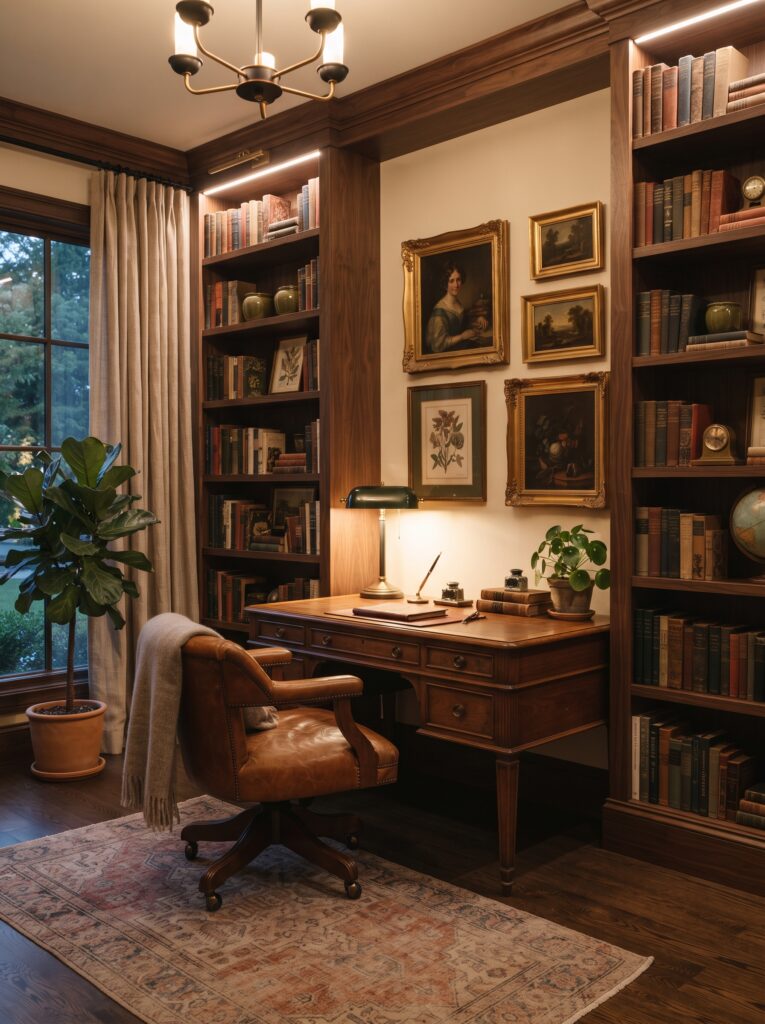
A library-style home office combines the comfort of a reading room with the practicality of a productive workspace. Think rich walnut wood, built-in bookshelves, vintage-inspired artwork, warm lighting, comfortable seating, natural textiles, brass accents, and carefully selected objects that give the room personality.
This style works particularly well for American homes because it can be adapted to everything from a dedicated office to a small spare bedroom, reading room, study corner, or multifunctional guest room.
If you are searching for home office ideas, library-inspired office decor, cozy home office inspiration, dark wood office ideas, home library design, or elegant work-from-home spaces, these ideas can help you create a room that feels sophisticated without becoming overly formal.
Why Library-Inspired Home Offices Are So Appealing
For years, home office design leaned heavily toward minimalism.
Clean white desks, simple shelving, neutral walls and almost invisible storage became popular because they made spaces feel uncluttered.
But many homeowners are now looking for something with more personality.
The current direction in interior design is increasingly focused on rooms that feel collected, comfortable and personal. Designers are incorporating richer wood tones, vintage details, layered lighting, natural materials and objects that tell a story rather than making every room look identical. Fall 2026 design coverage has also highlighted dark woods, vintage character, handcrafted details and warmer interiors.
A library-inspired office fits naturally into this shift.
It gives you a chance to combine productivity with atmosphere.
Instead of asking, “How can I make my office look professional?” the better question becomes:
“How can I make my workspace feel like somewhere I actually want to spend time?”
1. Start With Rich Walnut Wood
Wood is one of the easiest ways to create a library atmosphere.
Walnut is particularly effective because its naturally deep brown color provides warmth and visual depth.
You can use walnut for:
- A writing desk
- Built-in bookshelves
- Floating shelves
- Storage cabinets
- Picture frames
- A side table
- Decorative boxes
- Desk accessories
You do not need every piece of furniture to be walnut.
In fact, mixing wood finishes can make the room look more authentic.
For example, a walnut desk can work beautifully with slightly lighter oak shelves or an antique-style wooden chair.
The goal is to create a layered material palette rather than a perfectly matched furniture set.
2. Build a Statement Bookshelf
Nothing communicates “library-inspired” more quickly than a beautiful bookshelf.
If your budget allows, built-in shelving can make a home office feel custom-designed.
But freestanding bookcases can create a similar effect.
Try arranging books in a mixture of horizontal and vertical stacks.
Leave some empty space between groups instead of filling every shelf.
This breathing room allows decorative objects to stand out.
You can also incorporate:
- Ceramic vessels
- Small sculptures
- Framed photographs
- Vintage-style clocks
- Decorative boxes
- Brass objects
- Small plants
- Personal collections
The important thing is to avoid making the bookshelf look like a storage warehouse.
A library-inspired office should feel curated, not crowded.
3. Mix Books With Decorative Objects
One of the easiest styling mistakes is arranging books perfectly by color.
Although color-coordinated bookshelves can look attractive in photographs, they can sometimes feel overly staged.
A more natural approach is to allow books to remain part of the room’s personality.
Stack a few books horizontally.
Place others vertically.
Add a small ceramic object on top of one stack.
Leave another shelf almost empty.
This creates visual rhythm.
Your shelves should communicate that the room is actually used.
That lived-in quality is one of the characteristics that makes traditional and collected interiors feel inviting.
4. Choose a Classic Writing Desk
A library-style office benefits from a desk that looks like furniture rather than office equipment.
Consider:
- A walnut writing desk
- A vintage-inspired executive desk
- A simple wooden writing table
- A campaign-style desk
- A traditional pedestal desk
The desk should provide enough space for your actual work.
If you use multiple monitors, choose a larger surface and manage cables carefully.
If you mostly write, read or use a laptop, a smaller writing desk may be enough.
The goal is to preserve visual simplicity without sacrificing function.
5. Choose a Comfortable Chair
A beautiful office chair is useless if you cannot comfortably sit in it.
This is one area where style should never completely override function.
Look for a chair with:
- Proper back support
- Comfortable cushioning
- Appropriate desk height
- Durable upholstery
- A shape that complements the room
Leather can create a classic library feeling, especially in cognac, camel or deep brown.
But upholstered chairs in linen or textured fabric can create a softer interpretation of the style.
If you work from home for long periods, prioritize ergonomic support even if the chair is eventually hidden beneath a beautiful throw or cushion.
6. Use Warm Lighting Instead of One Ceiling Light
Lighting can make or break a library-inspired office.
A single bright ceiling fixture can make even beautiful furniture feel cold.
Instead, layer several light sources.
Consider:
- A desk lamp
- A floor lamp
- Wall sconces
- Picture lights
- A ceiling fixture
- Accent lighting inside shelves
The objective is to create multiple pools of light.
During the day, natural light should do most of the work.
In the evening, warmer lamps can make the room feel more intimate.
This is particularly useful if your office doubles as a reading room.
7. Add an Aged Brass Desk Lamp
A brass desk lamp is a small detail with a large visual impact.
Aged brass works particularly well with dark wood because the warm metallic finish breaks up the deeper tones.
Look for designs with:
- A traditional shade
- Adjustable arm
- Vintage-inspired silhouette
- Matte or aged finish
You can repeat the brass elsewhere in the room through drawer pulls, picture frames, hardware or a small decorative object.
Avoid using too many metallic finishes.
One dominant metal generally makes the space feel more cohesive.
8. Create a Gallery Wall
A library-style office does not need to be filled exclusively with books.
Artwork can introduce personality.
Try creating a small gallery wall using:
- Landscape paintings
- Botanical prints
- Architectural drawings
- Vintage maps
- Abstract artwork
- Family photographs
- Black-and-white photography
The frames can be mixed, but try to maintain a consistent visual language.
For example, dark wood and aged brass frames can work beautifully with walnut furniture.
You can also use one large artwork instead of a gallery wall if you prefer a cleaner appearance.
9. Choose the Right Wall Color
Wall color can dramatically influence the feeling of a library-inspired office.
For a lighter interpretation, choose:
- Warm white
- Cream
- Soft beige
- Mushroom
- Pale taupe
For a moodier room, consider:
- Deep olive
- Muted charcoal
- Chocolate brown
- Warm navy
- Deep forest-inspired green
Dark walls can look especially dramatic when combined with walnut shelving and warm lighting.
However, a small office does not automatically require white walls.
A darker color can make a compact room feel intentional and intimate.
The key is to balance the depth of the walls with appropriate lighting and lighter decorative elements.
10. Add a Vintage-Inspired Rug
A rug can make a home office feel considerably more finished.
Instead of choosing an extremely bold pattern, consider a vintage-inspired rug with muted colors.
Look for combinations such as:
- Cream and brown
- Olive and beige
- Rust and ivory
- Faded blue and tan
- Burgundy and neutral
- Taupe and charcoal
The pattern should complement the furniture rather than compete with it.
A rug also helps visually define the office if your workspace is located inside a larger room.
11. Introduce Leather Carefully
Leather can make a library-inspired office feel sophisticated, but too much leather can make the room feel overly formal.
One leather element is usually enough.
For example:
Walnut desk + leather chair + linen curtains
or
Wood desk + upholstered chair + leather desk accessories
Cognac leather is particularly versatile because its warm undertones complement walnut, cream, brass and earthy colors.
12. Use Linen Curtains
Window treatments are often overlooked in home offices.
Bare windows can make a room feel unfinished.
Linen or linen-look curtains introduce softness while allowing natural light to remain part of the space.
Choose warm neutrals such as:
- Ivory
- Oatmeal
- Natural
- Beige
- Soft taupe
If privacy is important, layer curtains with shades or blinds.
The combination creates a more polished appearance without making the room feel heavy.
13. Add Greenery for Balance
Plants can prevent a dark wood office from feeling too serious.
You do not need a jungle.
One or two thoughtfully selected plants may be enough.
Consider:
- Olive trees
- Fiddle-leaf figs
- Pothos
- Snake plants
- Ferns
- Small tabletop plants
If your office has limited natural light, choose plants appropriate for the available conditions rather than choosing purely based on appearance.
A plant also introduces a natural green tone that works beautifully with walnut and brass.
14. Create a Dedicated Reading Corner
If you have enough space, add a separate reading chair.
This can transform the office from a purely functional workspace into a multifunctional retreat.
Place a comfortable chair near:
- A floor lamp
- A small side table
- A bookshelf
- A window
Add a small cushion or throw.
Now the room can support several activities.
You can work at the desk, read in the chair, plan your week, or simply step away from the computer for a few minutes.
This type of flexibility is especially useful in American homes where one room often needs to serve multiple purposes.
15. Use a Desk Tray to Control Clutter
Even the most beautiful office can become messy quickly.
A simple desk tray can keep everyday objects organized.
Use it for:
- Pens
- Notebooks
- Glasses
- Charging accessories
- Small stationery
- Keys
Keep frequently used items accessible while hiding unnecessary visual clutter.
The objective is not to make the desk completely empty.
It is to make the room feel intentional.
16. Hide Technology Whenever Possible
A library-inspired office can quickly lose its character when cables and technology dominate the room.
Use cable-management solutions to keep wires organized.
Consider:
- Cable clips
- Under-desk cable trays
- Cord boxes
- Hidden power strips
- Wireless accessories where practical
If you use monitors, position them so that they do not visually overwhelm the desk.
Technology should support the room rather than become its main decorative feature.
17. Give the Office a Personal Story
This may be the most important part.
Your office should not look like a furniture catalog.
Add things that actually mean something to you.
Perhaps that means:
- Travel souvenirs
- Family photographs
- Favorite books
- Artwork from a local artist
- A vintage object
- A handwritten note
- A collection of ceramics
- A meaningful inherited piece
These objects give the office identity.
The most beautiful library-inspired rooms often feel as though they evolved gradually rather than being purchased all at once.
18. Create a “Quiet Luxury” Feeling Without Overspending
You do not need expensive furniture to create a sophisticated workspace.
Instead, concentrate on a few high-impact details.
Spend more attention on:
Lighting
Wood tones
Hardware
Textiles
Artwork
Organization
A simple desk can look considerably more expensive when surrounded by good lighting, beautiful artwork and organized shelves.
Likewise, inexpensive accessories can look elevated when they are used selectively rather than scattered throughout the room.
19. Small Home Office? You Can Still Create the Look
A library-inspired workspace does not require a huge room.
For a small office, use vertical space.
Install:
- Tall bookshelves
- Floating shelves
- Wall-mounted lighting
- A compact desk
- One comfortable chair
Keep the floor relatively open.
A narrow writing desk can work surprisingly well against a wall.
Use a large mirror carefully if you want to reflect light and visually expand the room.
For a small office, avoid filling every available surface.
Negative space is important.
20. Make the Office Feel Good at Night
The evening version of your office can be completely different from the daytime version.
Turn off harsh overhead lighting.
Use your desk lamp and floor lamp instead.
Switch on shelf lighting if you have it.
Light a candle if appropriate and safe.
Close the curtains.
Put your phone away.
The room can then become a quiet space for reading, journaling or planning rather than remaining visually associated with work.
This is one reason the library concept works so well: it creates an environment that supports both productivity and relaxation.
A Simple Formula for a Library-Inspired Home Office
If you want an easy formula to recreate this look, start with:
Walnut wood + comfortable chair + bookshelves + warm lighting + vintage artwork + brass accents + natural textiles
Then personalize it.
You might add a plant, a vintage rug, leather accessories or a reading chair depending on your available space.
The result should feel warm rather than formal.
Common Home Office Styling Mistakes
Making Everything Too Modern
Ultra-minimal furniture can work, but if you want a library atmosphere, incorporate at least a few traditional or vintage-inspired elements.
Filling Every Shelf
Empty space is part of good shelf styling.
Choosing Style Over Comfort
Your chair, desk height and lighting should support your actual work.
Using Only One Light Source
Layered lighting creates much more atmosphere.
Making the Room Too Dark
Dark wood is beautiful, but balance it with cream textiles, natural light and warm lamps.
Buying Everything at Once
A collected room looks better when it evolves.
Start with the major pieces and gradually add objects that genuinely fit your personality.
Conclusion
A library-inspired home office offers a beautiful alternative to the typical minimalist workspace. It combines productivity, comfort, personality and timeless style in one room.
Walnut furniture creates warmth. Bookshelves provide character. Vintage artwork adds personality. Brass introduces subtle elegance. Linen softens the space. Layered lighting creates an atmosphere.
Most importantly, this design approach allows your office to feel like part of your home rather than a separate corporate environment. Whether you have an entire dedicated study or only a small desk in a spare room, you can borrow the essential elements of the library aesthetic and create a workspace that feels calm, sophisticated and genuinely personal.
The goal is not to create a perfect office. The goal is to create a space where you enjoy sitting down, opening a book, finishing your work, and staying for a little while longer.
- Staircase Wall Decor Ideas: How to Create a Collected Gallery Look
- Library-Inspired Home Office Ideas That Make Working From Home Feel Luxurious
- Chocolate Brown Dining Table Ideas for a Warm and Elegant Fall Home
- Playful Home Decor Ideas That Feel Fun, Stylish, and Unexpected
- Unexpected Wallpaper Ideas That Make Ordinary Spaces Feel Custom